Phoenix Real Estate Market 2026: Prices, Rents and Yields
Phoenix is the largest housing market in the American Southwest and, in 2026, one of its most orderly: the typical home value of $410,222 is off 2.1% on the year, five-year growth stands at 14.0%, and the $1,569 median asking rent holds gross yield at 4.59%.
No boom, no bust — a big, liquid, slightly cooling market. In this article, we'll look at where the metro stands, which suburbs carry which strategy, and what an international buyer should verify before committing.
1. Where Phoenix Prices Stand in 2026
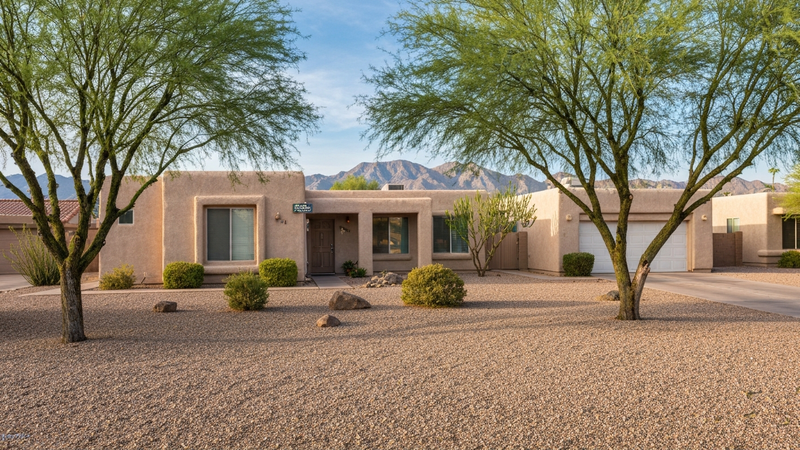
The metro's cooling is remarkably even: Phoenix -2.1%, Tucson -2.2%, Mesa -1.4%, Chandler -1.8%, Gilbert -0.8%. Nothing in the Arizona data resembles distress; it reads as a market digesting its 2020-2022 run at different speeds by price tier.
The east valley — Chandler and Gilbert — trades at a $110,000-$160,000 premium to the city on newer stock and semiconductor-corridor employment. Tucson remains the state's value market at $325,520.
| City | Typical value | 1-yr | 5-yr | Gross yield |
|---|---|---|---|---|
| Phoenix | $410,222 | -2.1% | +14.0% | 4.59% |
| Mesa | $434,616 | -1.4% | +14.8% | 4.28% |
| Chandler | $521,563 | -1.8% | +14.7% | 4.38% |
| Gilbert | $572,453 | -0.8% | +17.8% | 4.23% |
| Tucson | $325,520 | -2.2% | +17.2% | 5.25% |
Zillow ZHVI and ZORI, mid-2026. Gross yield is annualized rent divided by typical value, before all costs.
Arizona's full series, with ten years of state history, is on our Arizona market page.
How the last five years set up 2026
Arizona's decade gain of 90.5% included one of the country's sharpest pandemic-era runs, followed by one of its earliest corrections — Phoenix cooled in 2022 before most metros. That early reset is why the five-year figure still reads +14.0% while this year's decline is a shallow -2.1%: the excess was worked off sooner here.
A 2026 buyer therefore inherits a market that has already done its violent adjusting. Prices have drifted, not lurched, for three years, and the demand story has shifted from migration-driven speculation to payroll-driven fundamentals as the fab construction converts to production employment.
2. Rents, Yields and the Semiconductor Corridor

Phoenix's 4.59% gross sits in the productive middle of the US range — below Atlanta, well above the coasts. What differentiates the metro is the demand story: tens of billions of dollars of semiconductor and supplier investment in the north and east valley has been adding high-wage manufacturing employment on a multi-year schedule.
For landlords, that shows up as tenant depth in Chandler, Gilbert and north Phoenix. The trade-off is that the same corridors attract heavy new-build supply, which keeps rent growth disciplined. Tucson offers a full point more gross yield with a thinner, university-anchored tenant base.
Run the gross-to-net sequence in our rental yield guide — and note that summer cooling costs are a genuine Arizona operating line that out-of-state models routinely miss. Property taxes are set by county and district; confirm the parcel's bill with the county assessor.
A worked example at the citywide numbers
At the $410,222 typical value and $1,569 median rent, full occupancy collects $18,828 a year — the 4.59% gross. Deduct property tax, insurance, HOA dues where applicable, 8-10% management, maintenance with the air-conditioning reserve Arizona demands, and a month of vacancy: the unlevered net lands near $11,000-$13,000, or 2.7-3.2%.
Tucson runs the same exercise from a $325,520 entry and $1,425 rent, netting roughly 3.2-3.7%. The half-point spread is the price of Phoenix's deeper tenant pool and better liquidity — a trade each investor should make consciously rather than by default.
3. Financing and Structure for International Buyers
Residential purchases in metro Phoenix carry no citizenship requirement, and the lending market is deep in foreign national and DSCR programs at 25-30% down. Arizona has restricted certain land purchases near military installations by specific foreign entities; standard metro residential deals are outside those rules, but confirm anything unusual with an Arizona attorney.
Most valley communities are HOA-governed — review budgets, reserves and rental caps before contract, since some associations limit the share of homes that may be rented. If short-term rental income is part of the plan, Arizona cities license and regulate it individually; see our short-term rental rules guide for the framework.
Structure and financing details are in our holding structures guide and foreign national mortgage guide.
The purchase timeline from abroad
Arizona closes through escrow and title companies on a standardized purchase contract with a defined inspection period — ten days by default — that gives buyers a clean exit on diligence findings. A financed purchase typically runs 30-40 days; cash can close in two weeks.
Overseas execution is routine: power of attorney or remote online notarization, international wire for funds, delegated walkthrough. The full remote process is described in our guide to buying without flying in.
4. The Case Against Phoenix — and the Rebuttal

The bear case has two words: water and heat. Skeptics argue that groundwater limits will eventually cap the metro's growth model, that 110-degree summers strain livability and operating costs, and that the post-2020 in-migration wave has already crested — visible in this year's -2.1%.
The rebuttal is that Arizona prices these risks more explicitly than almost any state: new development in central Arizona must demonstrate long-term water supply, utilities plan around extreme heat as a design condition, and the semiconductor buildout is committed capital on a decade horizon, not sentiment. The risks are real; they are also underwritten, which is more than most markets can say about theirs.
What we watch from here: fab hiring announcements converting to occupied houses in the northwest valley, east valley rent growth against its new-supply pipeline, and any change to central Arizona's water-supply certification rules for new development. The first two confirm the demand story; the third would reshape the supply story — in either direction.
For the cross-market view, our metro comparison sets Phoenix beside nineteen other markets on the same measures.
Final Thoughts: Who Phoenix Fits

Phoenix fits the buyer who wants a large, liquid Sun Belt market with a committed industrial demand story and is content with balanced numbers — 4.6% gross, mid-teens five-year growth — rather than an extreme on either axis. Tucson is the yield tilt; Chandler and Gilbert are the quality tilt.
Markets that have already corrected, kept their demand story and stayed liquid are the ones professionals quietly accumulate. Phoenix in 2026 checks all three boxes without requiring a heroic assumption on any of them.
We support international buyers through underwriting, financing introductions and closing, with brokerage services provided through licensed professionals. Contact our team to test the numbers on a specific property before you commit.
Reinvent NY provides business consulting, operational support, and coordination services. Legal advice and immigration filings are handled by independent licensed attorneys. Real estate services are provided through licensed professionals and applicable brokerage relationships. This article is for informational purposes only and does not constitute legal or investment advice.
More market reports: Austin Real Estate Market 2026, California Real Estate Market 2026, Chicago Real Estate 2026. The full set is indexed under market data for all 51 states.

Satoshi Onodera
Founder & CEO, Reinvent NY Inc.
Founded Reinvent NY in 2019. Providing relocation support from all over the world to America.
Ready to Get Started?
Our team in New York is ready to help with your visa, real estate, or relocation needs.
Schedule a ConsultationFrequently Asked Questions
How much does a home cost in Phoenix in 2026?
Zillow's typical home value for Phoenix is $410,222 as of mid-2026, down 2.1% over the past year. Arizona statewide sits at $422,822, down 1.6%.
What is the rental yield in Phoenix?
About 4.59% gross — $1,569 median asking rent against a $410,222 typical value, before taxes, insurance and management. Tucson runs higher at 5.25%.
Are Phoenix home prices falling in 2026?
Modestly. The city is down 2.1% year over year and every major Arizona city in our data is slightly negative, with Gilbert holding best at -0.8%. Five-year growth remains 14-18% across the metro.
Can a non-US resident buy property in Arizona?
Yes. Arizona imposes no citizenship or residency requirement on residential ownership in metro Phoenix. Buyers without US credit typically use foreign national or DSCR loans with 25-30% down.
Which Phoenix suburb is best for investors?
It depends on the target tenant. Mesa is the volume rental market, Chandler and Gilbert skew to newer stock and higher-income tenants at 4.2-4.4% gross, and Tucson — a separate metro — carries the state's highest gross yield at 5.25%.
What is the biggest risk in the Phoenix market?
Water and heat are the long-term questions investors ask most. Growth planning in central Arizona now explicitly manages groundwater supply, and cooling costs are a real operating line — both belong in your underwriting rather than your fears.
Real Estate Guides & Data
Related Articles
The Majestic: Chanin's Other Deco Towers on the Park
The Majestic replaced a Victorian hotel in 1931 with Art Deco twin towers and corner windows. See its recorded sales since 2023 and the median price.
The Century: Chanin's Art Deco Tower on the Park
The Century closed the southern end of Central Park West in 1931 with Irwin Chanin's Art Deco twin towers. Recorded sales since 2023 and the median price.
35 Hudson Yards: Limestone in a District of Glass
35 Hudson Yards is the limestone tower in a glass district, with residences above a hotel and offices. See its recorded sales since 2023 and the median price.
Las Vegas Real Estate Market 2026: Prices, Rents, Yields
Las Vegas home values in 2026: a $425,535 typical value after a 3.1% dip, $1,722 rents, a 4.86% gross yield, and how Henderson and Reno compare for investors.