Las Vegas Real Estate Market 2026: Prices, Rents, Yields
Las Vegas enters 2026 as a market cooling off a very strong run. The typical home value of $425,535 is down 3.1% on the year — yet still up 23.8% over five years, and the $1,722 median asking rent holds gross yield at 4.86% in a state with no personal income tax.
The combination of Sun Belt yield, tax treatment and famously liquid housing stock keeps this market on international shortlists. Let's examine the numbers, the financing route, and the honest case against.
1. Where Las Vegas Prices Stand in 2026
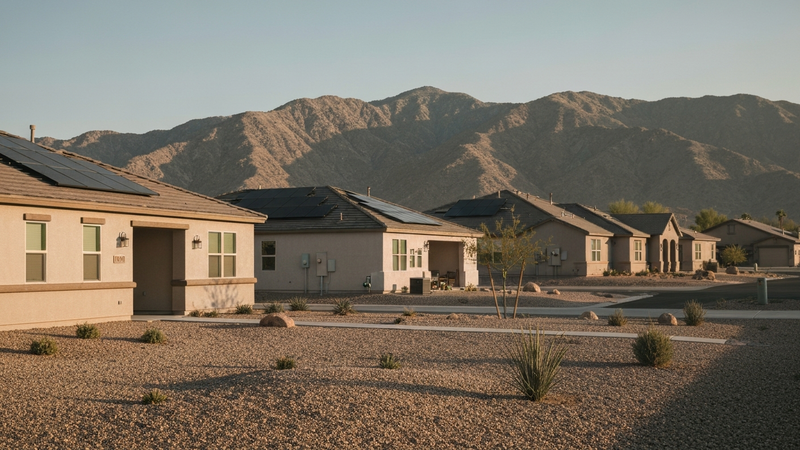
The valley is down 3.1% year over year, with Henderson — the metro's premium suburb — down 2.6% at $486,533. North Las Vegas, the value corridor, has held better at -1.8% and carries the metro's strongest five-year growth at 24.9%.
Northern Nevada runs on a different clock. Reno (+0.3%) and Sparks (+0.7%) are the only cities in our Nevada data positive on the year, supported by logistics and manufacturing employment rather than the Strip.
| City | Typical value | 1-yr | 5-yr | Gross yield |
|---|---|---|---|---|
| Las Vegas | $425,535 | -3.1% | +23.8% | 4.86% |
| North Las Vegas | $408,280 | -1.8% | +24.9% | 5.43% |
| Henderson | $486,533 | -2.6% | +20.8% | 4.50% |
| Reno | $576,913 | +0.3% | +15.0% | 4.02% |
| Sparks | $537,388 | +0.7% | +14.5% | 4.63% |
Zillow ZHVI and ZORI, mid-2026. Gross yield is annualized rent divided by typical value, before all costs.
The state series, including ten years of history, is on our Nevada market page.
How the last five years set up 2026
Nevada's 93.3% decade gain came in waves — a long recovery from the deep 2010s trough, then a sharp 2020-2022 leg that added most of the five-year figure of 21.2%. The current -2.1% statewide is the first sustained give-back since that leg, and it has been orderly rather than disorderly.
The important context: today's decline is happening with employment growing and inventory normal, which is what differentiates a rate-driven cooling from a demand collapse. Buyers who remember this metro's history watch that distinction closely, and so far 2026 is firmly the former.
2. Rents, Yields and the No-Income-Tax Math

At 4.86% gross in the city and 5.43% in North Las Vegas, the valley's rent-to-price ratio works where coastal metros fail. Nevada adds two structural advantages: no state personal income tax on the rental income, and property tax rules that cap annual increases — verify the current caps and the parcel's bill with the Clark County assessor.
The tenant base is broad but wage-sensitive: hospitality, healthcare, logistics and construction. Rent growth follows the tourism cycle more tightly than in diversified metros, which is why conservative underwriting assumes flat rents through a downturn rather than steady escalation.
Work the full gross-to-net sequence in our rental yield guide before comparing Las Vegas offers — the tax advantage only matters if the operating numbers hold.
A worked example at the citywide numbers
At the $425,535 typical value and $1,722 median rent, full occupancy collects $20,664 a year — the 4.86% gross. Deduct property tax per the county assessor, insurance, HOA dues typical of valley communities, 8-10% management and a month of vacancy, and the unlevered net settles near $12,500-$14,500, roughly 2.9-3.4%.
The same stack in North Las Vegas — $408,280 value, $1,846 rent — nets closer to 3.4-3.9%, before the state's zero income tax does its quiet work on the after-tax line. That gap between the two zip codes is the metro's real investment decision.
3. Financing and Structure for International Buyers

Nevada places no restriction on foreign ownership, and Las Vegas is among the smoothest US metros for overseas buyers: newer housing stock, HOA-managed communities, and lenders accustomed to foreign national and DSCR loans at 25-30% down.
Two diligence points. First, most valley communities carry HOA dues — get the association's budget and any planned assessments before contract. Second, short-term rental rules in Clark County and the city are strict and specific; if the plan involves anything other than a 12-month lease, read our short-term rental rules guide and confirm current local licensing first.
Entity structure decisions — personal name versus LLC — are covered in our holding structures guide, and financing detail in the foreign national mortgage guide.
The purchase timeline from abroad
Nevada closes through escrow and title companies, and the market's newer housing stock keeps diligence simple: a financed purchase typically runs 30-40 days, cash deals often close in two weeks. HOA resale packages are a standard deliverable and worth reading in full, not skimming.
Every step works remotely — power of attorney or remote notarization, international wires, delegated walkthrough. The overseas sequence is identical to what we outline in buying without flying in.
4. The Case Against Las Vegas — and the Rebuttal

The bear case is history. Las Vegas leans on tourism and construction, and in past national downturns it drew down harder than almost any US metro. Add this year's -3.1% and open desert on every edge of the valley for new supply, and some argue the market is a leveraged bet on the US consumer.
The rebuttal: the 2026 valley is not the 2008 valley. Employment has diversified into healthcare, logistics and professional sports; land around the valley is largely federally managed, which constrains sprawl more than the map suggests; and entry at 3% below last year with a 4.9-5.4% gross yield prices in much of the cyclical risk. Cyclical, yes — fragile, less so than its reputation.
What we watch from here: visitor volumes and convention calendars as the leading indicator of the tenant base, the pace of North Las Vegas industrial leasing as the diversification check, and whether the current -3.1% decline flattens by spring. A market this cyclical rewards buyers who track its cycle openly rather than pretending it does not exist.
See how Las Vegas ranks against nineteen other metros on identical measures in our metro comparison.
Final Thoughts: Who Las Vegas Fits

Las Vegas fits the income-focused buyer who wants Sun Belt yield plus Nevada's tax treatment and accepts tourism-cycle exposure in exchange. North Las Vegas is the yield play, Henderson the quality play, Reno the diversification play in the same tax regime.
A 3% discount to last year's prices, a near-5% gross yield and zero state income tax is a combination few US metros can print in the same sentence. The caveat is the cycle; the compensation is the price.
We support international buyers through underwriting, financing and closing, with brokerage services provided through licensed professionals. Contact our team to run the numbers on a specific property before you commit.
Reinvent NY provides business consulting, operational support, and coordination services. Legal advice and immigration filings are handled by independent licensed attorneys. Real estate services are provided through licensed professionals and applicable brokerage relationships. This article is for informational purposes only and does not constitute legal or investment advice.
More market reports: Austin Real Estate Market 2026, California Real Estate Market 2026, Chicago Real Estate 2026. The full set is indexed under market data for all 51 states.

Satoshi Onodera
Founder & CEO, Reinvent NY Inc.
Founded Reinvent NY in 2019. Providing relocation support from all over the world to America.
Ready to Get Started?
Our team in New York is ready to help with your visa, real estate, or relocation needs.
Schedule a ConsultationFrequently Asked Questions
How much does a home cost in Las Vegas in 2026?
Zillow's typical home value for Las Vegas is $425,535 as of mid-2026, down 3.1% over the past year. Nevada statewide sits at $448,215, down 2.1%.
What is the rental yield in Las Vegas?
About 4.86% gross — $1,722 median asking rent against a $425,535 typical value, before taxes, insurance and management. North Las Vegas runs higher at 5.43%.
Does Nevada have a state income tax?
No. Nevada levies no personal state income tax, which improves after-tax rental income for many owners. Property taxes are assessed locally and Nevada caps annual increases on existing owners — confirm details with the county assessor.
Can a foreign buyer purchase Las Vegas property?
Yes. Nevada imposes no citizenship or residency requirement on ownership. Buyers without US credit typically use foreign national or DSCR loans with 25-30% down.
Is the Las Vegas market falling in 2026?
Values are down 3.1% year over year after a strong five-year run of 23.8%. Reno and Sparks, in the north of the state, are the only Nevada cities in our data still slightly positive on the year.
Is Las Vegas riskier than other metros?
Historically yes — the metro's economy leans on tourism and construction, and it saw some of the deepest drawdowns in past national downturns. The 2026 economy is more diversified, but cyclicality remains the honest caveat.
Real Estate Guides & Data
Related Articles
Phoenix Real Estate Market 2026: Prices, Rents and Yields
Phoenix home values in 2026: a $410,222 typical value, $1,569 rents and a 4.59% gross yield — plus how Tucson, Mesa, Chandler and Gilbert compare for buyers.
35 Hudson Yards: Limestone in a District of Glass
35 Hudson Yards is the limestone tower in a glass district, with residences above a hotel and offices. See its recorded sales since 2023 and the median price.
River House: The 1931 Building at the End of 52nd Street
River House was built in 1931 with a private courtyard on the East River. See the sales the city has recorded there since 2023 and the median price.
The Eldorado: Art Deco Twin Towers on the Park
The Eldorado closed the Central Park West skyline in 1931 with Art Deco twin towers. See the sales the city has recorded there since 2023 and the median price.