Chicago Real Estate 2026: 8.6% Yield in a Rising Market
Chicago is doing something almost no other large American market managed in 2026: rising while yielding. The typical home value of $335,521 is up 3.9% on the year, and $2,409 median asking rent produces a gross yield of 8.62% — the highest of any top-ten US metro.
Investors who screened the country by yield alone would have found it years ago. The reason most did not is Illinois property tax. Let's look at both sides.
1. Where Chicago Prices Stand in 2026
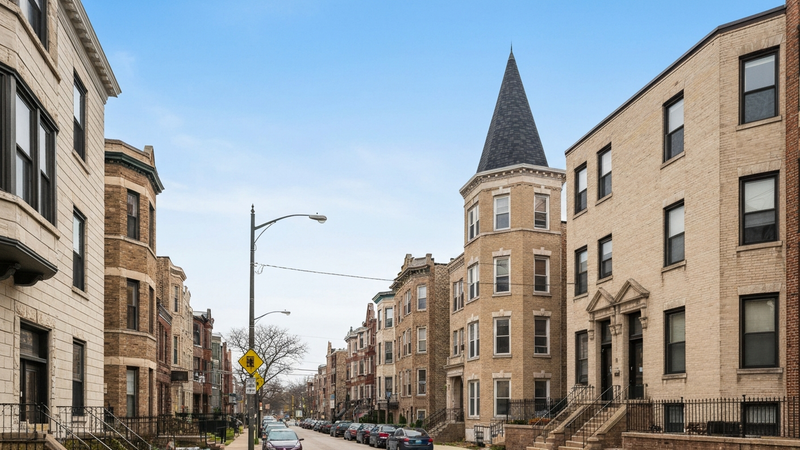
The city is up 3.9% year over year and Illinois overall is up 5.0% — among the few markets in our data positive on both measures. The decade gain of 66.9% is modest by national standards, and that restraint is precisely why there was nothing to correct.
The smaller Illinois cities have run harder. Rockford is up 61.6% over five years from a $187,245 base, and Aurora 37.1%. Naperville, the premium suburb, sits at $636,281 with a correspondingly thinner 4.36% yield.
| City | Typical value | 1-yr | 5-yr | Gross yield |
|---|---|---|---|---|
| Chicago | $335,521 | +3.9% | +11.2% | 8.62% |
| Aurora | $327,932 | +2.8% | +37.1% | 8.37% |
| Rockford | $187,245 | +9.9% | +61.6% | 7.74% |
| Joliet | $270,919 | +1.1% | +31.4% | 7.15% |
| Naperville | $636,281 | +4.4% | +38.9% | 4.36% |
Zillow ZHVI and ZORI, mid-2026. Gross yield is annualized rent divided by typical value, before property tax and all other costs.
Every Illinois city in the table is positive on the year, which is unusual in 2026. Full state detail is on our Illinois market page.
2. The Property Tax Line That Decides Everything

Illinois carries among the highest effective property tax rates in the United States, and in Cook County assessments are reviewed on a cycle that can move a bill materially. This is the reason Chicago's headline yield is not a free lunch.
Work the arithmetic. A $335,521 property at $2,409 rent grosses $28,908 a year. Deduct the actual parcel tax rather than a state average, insurance, management at 8-10%, maintenance on older Midwest housing stock and a month of vacancy: the unlevered net commonly lands near 4.5-5.5%.
That is still excellent — roughly double a coastal market after the same deductions. The discipline is to obtain the parcel's actual bill from the county assessor rather than modelling from an average, then run the sequence in our rental yield guide.
3. Financing and Structure for International Buyers

Illinois places no restriction on foreign ownership, and Chicago is one of the easier US metros to clear DSCR underwriting because the rent-to-price ratio is genuinely strong — the property's income covers the debt service comfortably at typical 25-30% down.
That is a meaningful practical advantage over coastal markets, where the same programme frequently fails on the numbers. A buyer who could not obtain financing for a San Diego rental can often obtain it here on the same balance sheet.
Illinois closes through title companies with attorney involvement customary, and a financed purchase typically runs 30 to 45 days. Structure decisions are in our holding structures article and the remote mechanics in buying without flying in.
4. The Counterargument: Population and Fiscal Risk

The bear case is serious and well known. Illinois and Cook County carry substantial pension obligations, the metro has lost population in several recent years, and both facts point in the same direction — toward property tax as the instrument of adjustment. An investor buying yield here is, in part, buying an exposure to that.
The rebuttal is that the market prices it already. Chicago trades at a third of Boston's typical value with a yield nearly twice as high, which is not a market that has overlooked its own fiscal position. Add a genuinely diversified employment base, an enormous rental population, transport infrastructure no Sun Belt metro can replicate, and prices that rose in a year when most fell. The risk is real; so is the compensation, and both are legible.
See where Chicago sits against the other high-income markets in our highest-yield cities analysis.
How the last five years set up 2026
Illinois added 29.7% over five years while Chicago itself added 11.2% — the growth went to Aurora, Rockford and Joliet rather than to the city. That divergence matters because it means the city entered 2026 without the froth its own state had accumulated.
A market that never rose sharply has nothing to hand back, which is the simplest explanation for why Chicago is positive on the year while Denver, Phoenix and Las Vegas are not. The 2026 buyer is paying close to a decade-long trend line rather than to a recent peak.
Where the submarkets diverge
A citywide median conceals a wide spread in a city this large. Neighbourhoods near the lakefront and the loop carry higher prices and thinner yields; the bungalow belt and the south and west sides invert both, sometimes dramatically.
Underwrite the block and the actual signed rents nearby rather than the citywide figure. In a city of two-flats and three-flats, the difference between adjacent streets is larger than the difference between many metros.
Final Thoughts: Model the Tax, Then Buy

Chicago suits the income investor who wants genuine cash flow in a large, liquid, transport-rich metro and is willing to underwrite Illinois property tax honestly rather than optimistically. The parcel's actual bill decides the deal, and it is knowable before any offer.
We underwrite specific properties including the parcel tax rate and arrange financing for overseas buyers, with brokerage services provided through licensed professionals. Talk to our team before you commit to an Illinois purchase.
For an overseas buyer weighing Chicago against the coastal gateways, the trade is explicit. New York and San Diego offer global resale recognition and thin income; Chicago offers genuine cash flow, a top-five metro economy and a resale pool that is national rather than international. Which matters depends entirely on whether the capital needs to work or merely to sit.
One further point in Chicago's favour for a remote owner: the professional services infrastructure is deep. Property managers, contractors, attorneys and accountants who handle non-resident owners routinely are abundant here in a way they are not in smaller high-yield markets, and that reduces the operational risk that usually accompanies strong income.
What we watch from here: whether the current price strength persists through a second year, how Cook County's next assessment cycle lands on residential parcels, and whether the metro's population trend stabilises. The first two are the ones that would change our underwriting; the third is slower and matters more over a decade than over a hold period.
Reinvent NY Inc. provides real estate and business expansion consulting in New York. This article is for informational purposes only and does not constitute legal, tax or investment advice.
More market reports: Hawaii Real Estate 2026, Los Angeles Real Estate Market 2026, San Francisco Real Estate Market. The full set is indexed under market data for all 51 states.

Satoshi Onodera
Founder & CEO, Reinvent NY Inc.
Founded Reinvent NY in 2019. Providing relocation support from all over the world to America.
Buying, renting or expanding to New York?
Our New York team helps international buyers, renters and companies with property and US business expansion.
Talk to our teamFrequently Asked Questions
How much does a home cost in Chicago in 2026?
Zillow's typical home value for Chicago is $335,521 as of mid-2026, up 3.9% over the past year. Illinois statewide sits at $298,871, up 5.0%.
What is the rental yield in Chicago?
About 8.62% gross — $2,409 median asking rent against a $335,521 typical value, before property tax, insurance and management. It is the highest of any top-ten US metro.
Why is Chicago rising while Sun Belt markets fall?
Chicago never had the 2020-2022 melt-up that other metros are now correcting. Prices stayed flat while rents rose, so the market entered 2026 without excess to give back.
What is the catch with Illinois property tax?
Illinois has among the highest effective property tax rates in the country, and Cook County assessments are reviewed on a cycle. This is the single line that separates Chicago's gross yield from its net.
Can a non-US resident buy in Chicago?
Yes. Illinois imposes no citizenship or residency requirement on ownership. Buyers without US credit typically use foreign national or DSCR loans at 25-30% down.
Is Chicago a good market for overseas investors?
For income, it is among the strongest large markets in the country. The requirements are honest tax modelling and local management, both of which are solvable.
Which Illinois cities offer more?
Rockford is up 61.6% over five years from a $187,245 base with a 7.74% yield, and Aurora combines 37.1% five-year growth with 8.37% gross — both stronger on paper than the city itself.
Real Estate Guides & Data
More guides
- Cost Segregation: Accelerating US Property Depreciation
- Divorce and NY Real Estate: Dividing the Apartment
- Exit Planning Five Years Out: Selling Starts Early
- Furnished and Corporate Rentals: The 30-Day-Plus Market
- How to Hold US Property: Personal, LLC or Corporation
- Inheriting US Property: The Heir's Playbook
Related Articles
Florida Real Estate for Foreigners 2026: Tax & Asset Guide
Buying Florida property as a foreign national in 2026: no state income tax, financing with 25-30% down, insurance costs, and the FIRPTA rules on exit.
FIRPTA Tax 2026: Rates, Withholding Rules & Exemptions
Learn FIRPTA tax rules for foreign investors selling US property. Covers current withholding rates, exemption thresholds, and filing deadlines.
Washington DC Real Estate Market 2026: Prices & Yields
The Washington DC real estate market shows post-pandemic resilience, offering international investors a stable entry point for long-term growth in the capital.
Los Angeles Real Estate Market 2026: Trends & ROI
Analyze Los Angeles real estate market trends for luxury investments in 2026. Discover strategic opportunities and high-net-worth asset growth.