Olympic Tower: The Building That Started Fifth Avenue
Olympic Tower invented the building type that Manhattan has been repeating ever since. Completed in 1976 at 641 Fifth Avenue beside St Patrick's Cathedral, developed by Aristotle Onassis and designed by Skidmore, Owings and Merrill, it combined retail, offices and residential condominium in a single tower at a time when New York did almost none of those things together.
Fifty years on, that model is the default for large development in the city. Let's look at what the original version offers a buyer today.
1. What the Building Is
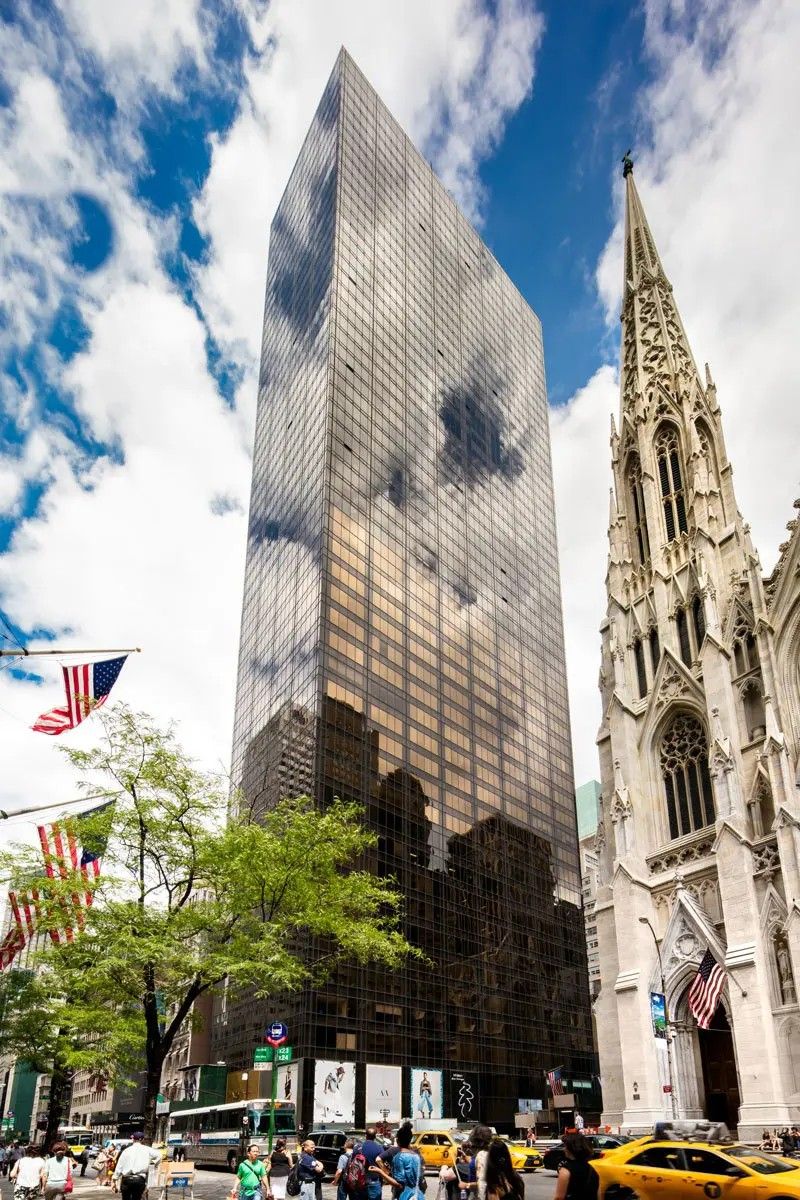
A bronze-tinted glass tower on the most commercial stretch of Fifth Avenue, holding three uses stacked in one structure: retail at the base, offices above, residences at the top. The arrangement is now so familiar that its originality in 1976 is easy to miss.
The residential portion was condominium, which was itself unusual in New York at the time. The city's apartment stock was overwhelmingly cooperative, and the condominium form that international buyers now take for granted was still establishing itself.
That combination — an early condominium, in a mixed-use tower, on Fifth Avenue — is why the building matters historically and why it still appeals to a specific kind of purchaser today.
| Attribute | Detail |
|---|---|
| Address | 641 Fifth Avenue, Manhattan |
| Completed | 1976 |
| Architect | Skidmore, Owings and Merrill |
| Developer | Aristotle Onassis |
| Uses | Retail, office and residential |
| Ownership | Condominium |
Building facts. Unit-level figures - size, exposure, charges, tax - must be obtained for the specific residence.
The location is on Google Maps here, directly beside St Patrick's Cathedral.
2. The Fifth Avenue Position
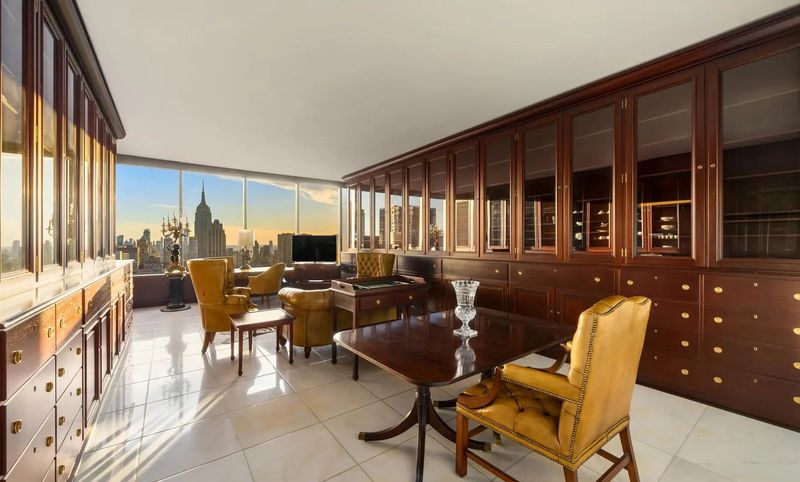
This block is among the most valuable retail frontage in the world, and that has consequences in both directions for a resident. The address needs no explanation anywhere on earth, which for an international resale market is a commercial asset rather than a vanity.
The corresponding reality is that the street below is a working commercial thoroughfare with heavy foot traffic, deliveries and tourist volume. That is the character of the location and no building on it can change that.
Whether it suits you is a question of use. For an apartment occupied part of the year by someone who wants Midtown at the door, it works well. For a family living here continuously with children, a quieter address usually serves better.
Ask for a live walkthrough that includes the street approach at a busy hour rather than an empty one. Our remote viewing guide covers how to run that properly from abroad.
3. Diligence in a Fifty-Year-Old Mixed-Use Tower

Two questions carry more weight here than in a new building. First, the capital plan. A tower completed in 1976 has facade, lift, mechanical and system items that reach the end of their life on a schedule, and the reserve study should say what is coming and how it is funded.
Second, cost allocation between the three uses. Retail, office and residential share a structure, and the documents determine which portion pays for what. Ask your attorney to identify exactly what the residential condominium bears.
Then the ordinary review: audited financial statements, the reserve balance in dollars, assessment history and two years of board minutes. A building of this age with a well-funded reserve is a better purchase than a new one with a thin one.
Our building diligence guide sets out the full list and how to read each document.
4. Buying Here as an Overseas Purchaser

Straightforward as a condominium: no board approval vote, non-resident and entity ownership accepted, subletting governed by building rules. In a Midtown surrounded by cooperative buildings that decline foreign purchasers as a matter of routine, that has real practical value.
Mansion tax applies from $1 million on the whole price, reaching 2.25% between $5 and $10 million and 3.25% above $10 million, paid by the buyer at closing. Common charges and property tax are separate and both should be obtained for the specific unit.
Settle ownership structure before contract; US estate tax reaches non-resident owners above a $60,000 exemption on US-situs assets. See our estate tax guide and buying from overseas guide.
What an early condominium means in practice
Buildings that adopted the condominium form early have decades of operating history under it, which is genuinely useful information. Assessment patterns, reserve behaviour and board decisions over that period are all documented and all readable.
That is an advantage over a new development where none of that record exists yet and every projection is a forecast. Ask for as much history as the managing agent will provide, and read the assessments in particular.
1970s floor plates versus contemporary ones
Apartments here follow a 1970s design logic rather than a current one. Ceiling heights, window arrangements and room proportions differ from what a buyer sees in new construction, and the variation between units within the building is wider.
Some of those apartments are exceptional. The only way to know which is to inspect the specific one, with dimensions and ceiling heights measured on camera rather than taken from a floor plan drawn for marketing.
Comparables in a building with a long record
Closed sale prices are public record in New York, and a building that has traded for decades produces a genuinely useful series rather than a handful of points. That makes valuation here more tractable than in a small new building with three closings to its name.
Use it. Our negotiation guide covers how to build a comparable set and how to adjust for floor, exposure and condition when the sales span several years.
Final Thoughts: The Original of a Familiar Type
Almost every large mixed-use tower built in New York since is a descendant of this one. That history is interesting but it is not the reason to buy here. The reason is a Fifth Avenue address in condominium form, in a building with fifty years of readable operating record, at a price that reflects its age rather than its position. Establish the capital plan and the cost allocation, and the rest is a straightforward decision.
We cover Fifth Avenue and Midtown on Satoshi Onodera's YouTube channel and on Instagram. If a unit here is in view, talk to our team and we will obtain the financials and the comparables first. Real estate brokerage services are provided through licensed professionals.
For a buyer weighing this against a new tower a few blocks north, the trade is legible. The new building offers current construction, deeper amenity and a higher carrying cost with no operating history. This one offers a proven record and a lower entry point in a structure that will need capital work on a known schedule.
Neither is the obvious answer. But a buyer who reads the reserve study and the assessment history of both will usually find the choice makes itself, and will make it on evidence rather than on which lobby impressed them more.
Reinvent NY provides business consulting, operational support, and coordination services. Legal advice and immigration filings are handled by independent licensed attorneys. Real estate services are provided through licensed professionals and applicable brokerage relationships. This article is for informational purposes only and does not constitute legal or investment advice.
More buildings worth knowing: The Brooklyn Tower, Central Park Tower, Mandarin Oriental Fifth Avenue Residences. The full set is indexed under New York building profiles.

Satoshi Onodera
Founder & CEO, Reinvent NY Inc.
Founded Reinvent NY in 2024. Providing relocation support from all over the world to America.
Ready to Get Started?
Our team in New York is ready to help with your visa, real estate, or relocation needs.
Schedule a ConsultationFrequently Asked Questions
Where is Olympic Tower?
641 Fifth Avenue, between 51st and 52nd Streets, beside St Patrick's Cathedral. The location is on [Google Maps](https://maps.google.com/?q=641+Fifth+Avenue+New+York).
When was it built?
It was completed in 1976, developed by Aristotle Onassis and designed by Skidmore, Owings and Merrill.
Why is the building historically significant?
It was one of the first buildings in Manhattan to combine retail, office and residential condominium uses in a single tower, a model that has been repeated across the city ever since.
Is it a condominium?
Yes. The residential portion is condominium ownership, which was still uncommon in New York when the building opened.
Can an overseas buyer purchase here?
Yes. As a condominium there is no board approval vote, and non-resident and entity ownership are generally accepted.
What are the main diligence questions?
The reserve balance and capital plan for a building of this age, how residential, office and retail costs are allocated, assessment history, and the actual monthly charges for the specific unit.
How do the layouts compare with newer towers?
The floor plates follow a 1970s design, so ceiling heights and window arrangements differ from contemporary construction. Inspect the specific apartment rather than reasoning from the building.
Real Estate Guides & Data
More guides
- Hotel Condos and Serviced Apartments
- Reading a US Lease: The Clauses That Cost You
- Managing a US Rental From Abroad: Choosing the Manager
- NYC Mortgage Recording Tax: The Cost of Borrowing
- Researching Neighborhoods From Abroad: The Remote Method
- Where to Buy in New York, by Neighbourhood
Related Articles
Bay Ridge Brooklyn Real Estate Guide 2026
An authoritative 2026 guide to Bay Ridge, Brooklyn real estate: housing stock, prices, rents, transit, and schools for international buyers and renters.
New York vs Miami Real Estate: A 2026 Investor View
Manhattan trades near $1,500 per square foot, Miami near $700. We compare yield, taxes, insurance, assessment risk and liquidity in the two markets.
Sunset Park Brooklyn: 2026 Real Estate Guide
A concrete guide to Sunset Park, Brooklyn for international buyers and renters: boundaries, housing stock, prices, transit.
Gowanus Brooklyn Real Estate Guide 2026
An expert 2026 guide to buying and renting in Gowanus, Brooklyn — housing stock, prices, transit, and lifestyle for international buyers.