The Brooklyn Tower: Brooklyn's First Supertall, Assessed
The Brooklyn Tower is the borough's first supertall, and it changed what the top of the Brooklyn market looks like. SHoP Architects' dark banded tower at 9 DeKalb Avenue rises from the landmarked former Dime Savings Bank, which was preserved rather than cleared.
For a buyer with a Manhattan budget, it poses a genuine question: what does crossing the river actually change? Let's work through it with the numbers.
1. What the Building Is
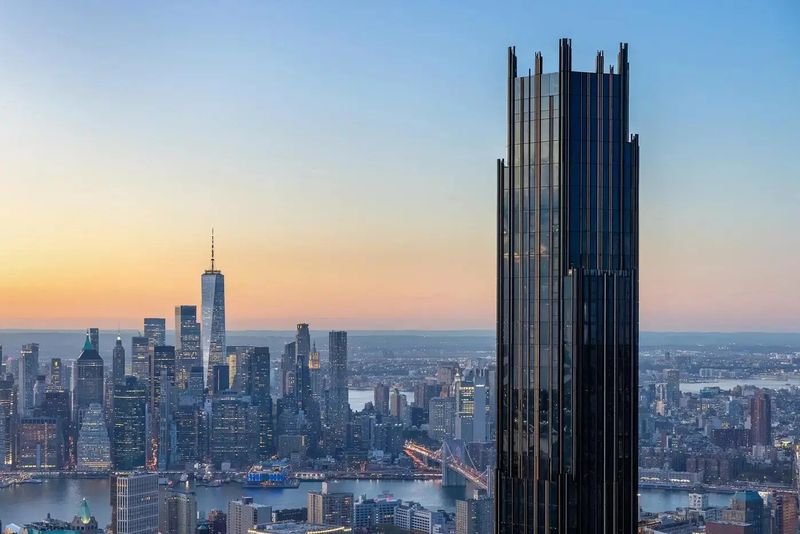
A tapering tower in dark cladding with bronze banding — deliberately unlike the pale glass across the East River. At its base sits the landmarked former Dime Savings Bank, a domed neoclassical banking hall incorporated into the development rather than demolished.
That combination is the building's argument: a supertall that belongs to Brooklyn rather than borrowing Manhattan's visual language, anchored in a piece of the borough's own history.
| Attribute | Detail |
|---|---|
| Address | 9 DeKalb Avenue, Downtown Brooklyn |
| Architect | SHoP Architects |
| Distinction | Brooklyn's first supertall building |
| Base building | Landmarked former Dime Savings Bank, preserved |
| Cladding | Dark banded facade with bronze detailing |
| Ownership | Condominium |
| Board approval | Right of first refusal only |
Building facts. Unit-level figures — size, charges, tax, exposure — must be obtained for the specific residence.
The location is on Google Maps here, a short walk from several subway lines into Manhattan.
2. What Crossing the River Actually Costs and Saves

The carrying cost difference is real and it compounds. Brooklyn condominium operating expense runs a median $10.92 per square foot a year against Manhattan's $15.52 — roughly $910 versus $1,293 a month on 1,000 square feet, before property tax.
Over a decade that gap is substantial, and it is before considering that the same budget generally buys more space here. What you give up is some international resale recognition: a global buyer who has never visited knows Manhattan addresses in a way they may not know Brooklyn ones.
Our Manhattan versus Brooklyn comparison works through the trade properly, including the borough-level running cost data behind those figures.
3. Being the Tallest Building in the Borough

There is an advantage here that Manhattan supertalls do not have: the views are not competing with neighbours of similar height. In Midtown a park outlook can be affected by the next tower to rise. In Downtown Brooklyn this building stands well above everything around it.
That said, being the first supertall in a borough means being the first of its kind rather than the last. Ask what is planned nearby and what the zoning permits, because the outlook you are paying for is only protected to the extent the surrounding sites cannot rise.
Our remote viewing guide covers how to establish what a view actually is when you cannot stand in the apartment yourself.
4. Buying Here as an Overseas Purchaser
Procedurally identical to Manhattan: a condominium, no board approval vote, non-resident and entity ownership accepted. Brooklyn's newer stock skews more heavily condominium than Manhattan's, which is why the borough frequently has more genuinely available inventory than a listing count suggests.
Mansion tax applies from $1 million on the whole price regardless of borough, and where units are sold by the sponsor the New York City and State transfer taxes are customarily shifted onto the purchaser — roughly 1.8 to 2.0% on top.
Settle ownership structure before contract; the $60,000 US estate tax exemption for non-residents applies here exactly as it does across the river. See our new development guide and estate tax guide.
What the preserved bank hall adds
Incorporating the former Dime Savings Bank gave the development an amenity space no new construction could produce: a domed neoclassical banking hall with proportions that a modern podium cannot imitate. It is the building's most distinctive interior by some distance.
It also brings landmark obligations. Preserved structures carry approval requirements and maintenance costs that the condominium funds, so ask how that portion is treated in the budget and the reserve study.
Downtown Brooklyn's transport position
The location sits close to one of the densest subway interchanges outside Manhattan, which is the practical reason the site supports a building of this scale. For a resident the relevant question is not how many lines exist but which specific station serves the building and how the journey actually runs at rush hour.
Verify the walk and the line for the specific apartment rather than relying on a borough-level claim. Our remote viewing guide covers how to have that filmed live rather than described.
Final Thoughts: A Different Choice, Not a Lesser One
The Brooklyn Tower suits a buyer who wants scale and a genuine view without Manhattan's carrying costs, and who is comfortable that the resale audience is deep but more national than global. For a buyer whose priority is the widest possible pool of future buyers, Manhattan remains the answer — and that is a preference about liquidity rather than a judgement about the building.
We cover Brooklyn and Manhattan on Satoshi Onodera's YouTube channel and on Instagram. If a line here is in view, talk to our team and we will obtain the financials and comparables first. Real estate brokerage services are provided through licensed professionals.
For an international buyer the honest summary is this. Brooklyn at this level is not a discount version of Manhattan; it is a different product with materially lower running costs and a resale audience that is deep domestically and thinner globally. A buyer who will use the apartment and hold it for years captures the cost advantage. A buyer who may need to sell quickly to an overseas purchaser should weigh the liquidity difference carefully before crossing the river.
A note on the borough's condominium supply that matters more for overseas buyers than for local ones. Brooklyn's newer inventory skews far more heavily condominium than Manhattan's largely cooperative stock, which means a much greater share of what appears in a Brooklyn search is genuinely available to a non-resident purchaser.
That is a practical advantage rather than a marketing point. In Manhattan a search of a hundred listings might contain thirty a foreign buyer could realistically pursue; in newer Brooklyn buildings that proportion is far higher, and the search time saved is real.
For a buyer deciding between boroughs, the useful exercise is to price the same total monthly carrying cost on both sides of the river and see what each one buys in space and floor height. Done honestly, that comparison moves a meaningful number of buyers across the bridge — and sends others firmly back, which is equally useful information.
Reinvent NY provides business consulting, operational support, and coordination services. Legal advice and immigration filings are handled by independent licensed attorneys. Real estate services are provided through licensed professionals and applicable brokerage relationships. This article is for informational purposes only and does not constitute legal or investment advice.
More buildings worth knowing: 111 West 57th Street, 432 Park Avenue, 53 West 53rd. The full set is indexed under New York building profiles.

Satoshi Onodera
Founder & CEO, Reinvent NY Inc.
Founded Reinvent NY in 2024. Providing relocation support from all over the world to America.
Ready to Get Started?
Our team in New York is ready to help with your visa, real estate, or relocation needs.
Schedule a ConsultationFrequently Asked Questions
Where is The Brooklyn Tower?
9 DeKalb Avenue in Downtown Brooklyn, adjoining the landmarked former Dime Savings Bank. The location is on [Google Maps](https://maps.google.com/?q=9+DeKalb+Avenue+Brooklyn).
Why is it significant?
It is Brooklyn's first supertall building, and by a wide margin the borough's tallest — a structural change in what Brooklyn's skyline and its top of market look like.
Who designed it?
SHoP Architects, in dark banded cladding that reads very differently from the glass towers across the river.
What is the bank building?
The landmarked former Dime Savings Bank at the base was preserved and incorporated into the development, housing amenity and retail space.
How do costs compare with Manhattan?
Brooklyn condominium operating expense runs a median $10.92 per square foot a year against Manhattan's $15.52 — roughly $910 versus $1,293 monthly on 1,000 square feet, before property tax.
Can an overseas buyer purchase here?
Yes. It is a condominium, so there is no board approval vote and non-resident and entity ownership are accepted.
Is Brooklyn a compromise for a luxury buyer?
It is a different choice rather than a lesser one. Brooklyn trades some international resale recognition for materially lower carrying costs and more space per dollar.
Real Estate Guides & Data
Related Articles
DUMBO Brooklyn Real Estate Guide 2026
An expert 2026 guide to DUMBO, Brooklyn real estate: buildings, prices, rents, transit, and schools for international buyers.
Greenpoint Brooklyn Real Estate Guide 2026
A 2026 guide to buying and renting in Greenpoint, Brooklyn — housing stock, prices, transit, and who this waterfront neighborhood truly suits.
Williamsburg Brooklyn Real Estate Guide 2026
An expert 2026 guide to buying and renting in Williamsburg, Brooklyn: boundaries, buildings, prices, transit, and who the neighborhood truly suits.
Stuyvesant Town Manhattan: 2026 Real Estate Guide
Our 2026 guide to Stuyvesant Town covers buildings, prices, rents, transit, and daily life for buyers and renters considering this Manhattan enclave.