New York vs Miami Real Estate: A 2026 Investor View
A $2,000,000 budget buys roughly 1,300 square feet of Manhattan resale condominium at recent pricing. The same money buys close to 2,800 square feet in Miami Beach. That arithmetic drives a steady flow of investment capital south every year.
The square footage is cheaper. The ownership is not. Florida charges no state income tax, but Florida buildings now carry insurance premiums and mandatory structural reserve obligations that did not exist in their present form five years ago.
In this article, we'll compare the two markets on price per square foot, gross and net yield, tax and carrying cost, insurance and assessment risk, liquidity, and regulation — and identify which investor each city actually suits.
Price Per Square Foot: A Two-to-One Gap

Manhattan resale condominiums have recently traded in a range of roughly $1,400 to $1,600 per square foot, with new development and prime park-front product well above that. Treat the figure as an approximation — it moves by quarter and varies sharply by neighborhood and building age.
Miami and Miami Beach condominiums have generally run in the range of $600 to $800 per square foot, again approximate, with waterfront trophy buildings trading at multiples of it. The practical result is a two-to-one gap on comparable interior space.
| Metric | Manhattan | Miami / Miami Beach |
|---|---|---|
| Typical resale price per sq ft | Approx. $1,400-$1,600 | Approx. $600-$800 |
| Gross rental yield | Approx. 3%-4% | Approx. 5%-6% |
| State income tax on rental profit | Up to 10.9% state, plus city tax for residents | None |
| Annual property tax as share of value | Often under 1% for condos | Commonly around 2% |
| Buyer-side transaction tax | Mansion tax 1%-3.9% above $1M | None; doc stamps sit on the deed |
| Association charges plus insurance | Moderate and comparatively stable | Higher and materially repriced since 2022 |
Approximate ranges for comparison only. Actual figures vary by building, unit and tax year.
The table is the whole debate in one frame. Miami wins the entry price and the headline yield; New York wins the carrying cost profile and, as we'll see, the exit.
Why the gap persists
Manhattan is supply-constrained in a way South Florida is not. Roughly two thirds of Manhattan's apartment stock is cooperative rather than condominium, which keeps the freely purchasable pool small and supports a structural premium on condominiums.
Miami has answered demand with construction. That responsiveness caps price growth in ordinary cycles and lengthens the correction in weak ones — a dynamic our New York market analysis and the New York state market data both reflect.
Yield: Miami Wins on Paper, Then Gives Some Back
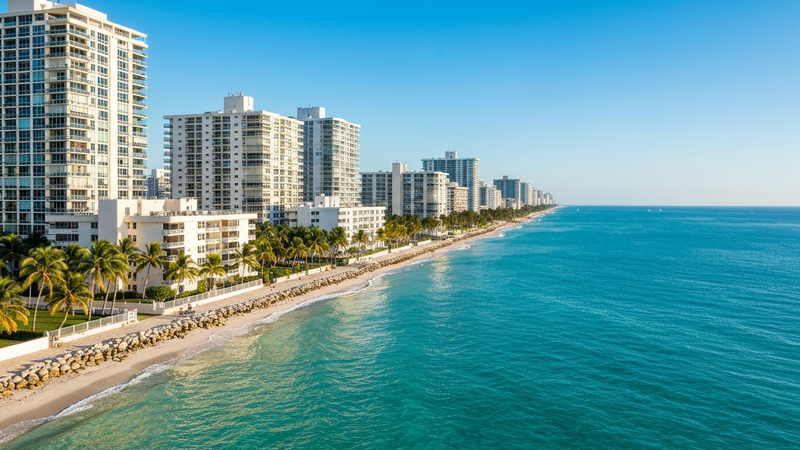
Gross rental yields in Miami commonly land around 5% to 6%, against roughly 3% to 4% in Manhattan. Both are approximations, and both are gross — calculated before a single expense line is deducted.
The gap is mostly a denominator effect. Manhattan rents are high in absolute dollars, but purchase prices are higher still, so the ratio compresses. Miami's lower entry price does most of the work.
From gross to net
Net yield is where the two converge. A Miami condominium carrying property tax near 2% of value, an association fee inflated by the building's master insurance policy, and a reserve contribution mandated by state law can surrender well over a third of gross rent before financing.
Manhattan runs the opposite pattern: lower property tax as a share of market value on most condominiums, more predictable common charges, and a state income tax bill on whatever profit survives. Our rental yield guide sets out the full calculation.
One further caution on Miami underwriting. Short-term rental income is frequently assumed and frequently unavailable — many associations prohibit rentals under six or twelve months, and Miami Beach enforces strict limits in most residential districts. Underwrite the annual lease, not the nightly rate.
Insurance, Assessments, and the Post-Surfside Repricing

The collapse of Champlain Towers South in Surfside in June 2021, which killed 98 people, changed the economics of Florida condominium ownership more than any market cycle has.
Florida's legislative response, Senate Bill 4-D of 2022 and its subsequent amendments, requires milestone structural inspections for condominium buildings three stories and higher at 30 years of age — earlier in certain coastal circumstances — plus a structural integrity reserve study and funded reserves for major components.
That is not a paperwork exercise. Associations that had deferred reserves for decades faced immediate funding gaps, and special assessments in the tens of thousands of dollars per unit — six figures in some older oceanfront buildings — have become a recognized feature of the market.
Insurance compounded it. Master-policy premiums at many coastal associations doubled or more between 2022 and 2024, with steeper increases in older buildings, before the 2022 litigation reforms and new carrier capacity began to moderate the trend.
The counterargument, and why it only half works
However, some argue the tax arithmetic swamps all of this. A New York rental generating $100,000 of taxable profit can attract roughly $10,000 a year in state income tax that a Florida owner simply never pays, and over a decade that is real money.
The rebuttal is that the two costs behave differently. Income tax is a share of profit and falls to zero when profit does. Insurance and assessments are fixed obligations that arrive whether or not the unit earns. A $120,000 assessment in a vacancy year has no offsetting income to shelter.
They also land in different places. Income tax touches cash flow; a funding shortfall touches the resale price, because the next buyer prices the liability in. Florida's tax advantage is genuine, but it is not insurance against the balance sheet.
Liquidity, Regulation, and Who Each Market Suits

Depth of market is the least discussed and most expensive difference between the two. Manhattan supports a continuous resale market across price bands, which matters when an exit is not optional.
Miami's condominium inventory rose sharply through 2024 and 2025 as owners reacted to assessments and insurance, lengthening marketing times in the older coastal stock in particular. Both markets draw international capital, but New York's buyer pool is broader across cycles.
| Risk factor | New York | South Florida |
|---|---|---|
| Windstorm exposure | Infrequent | The primary insurable peril |
| Flood exposure | Concentrated in mapped waterfront zones | Widespread, including tidal flooding |
| Assessment trigger | Facade cycles under Local Law 11 | Milestone inspections and reserve funding |
| Rent regulation | About one million stabilized units citywide | Minimal; Chapter 83 favors the landlord |
| Resale liquidity | Deep and continuous | Thinner, with elevated 2024-2025 inventory |
| Insurance trend | Rising modestly | Sharply higher since 2022, now moderating |
Risk profile comparison. Flood and windstorm exposure are property-specific and require a site-level review.
On regulation, one nuance is routinely missed. New York's rent stabilization system, tightened by the 2019 housing law, governs roughly a million apartments — but an individual condominium unit bought by an investor is almost always free-market. The regime matters to multifamily buyers, not to a single condominium.
Entry and exit friction
Round-trip transaction cost is the other liquidity variable. A New York City buyer pays the state mansion tax, which starts at 1% above $1,000,000 and steps up to 3.9% at the top of the scale, and the seller pays both the city transfer tax and a state transfer tax.
Florida is lighter. The documentary stamp tax on the deed runs $0.70 per $100 of consideration statewide, with Miami-Dade applying a $0.60 rate plus a surtax on property other than single-family homes, and it is customarily a seller cost.
Matching the market to the mandate
Miami suits the income-focused buyer who can absorb assessment volatility, wants no state income tax, and holds through cycles. Newer construction with a completed reserve study carries far less of the legacy risk than 1970s and 1980s oceanfront stock.
New York suits capital preservation, financing depth, and predictable exit. Buyers weighing the two should also compare the Florida state market data with New York's, and read our Miami condominium overview alongside the New York material.
Final Thoughts

Framed as a rivalry, this comparison produces a bad answer. Framed as two different instruments, it produces a usable one.
Miami is a yield play with a maintenance liability attached. New York is a capital play with a tax bill attached. The mistake we see most often is buying Miami on the gross yield and New York on the price per square foot, without pricing either liability.
Two items apply identically in both states and are worth settling early. Non-resident sellers face FIRPTA withholding on disposition, and federal rental income reporting obligations do not vary by state.
Before committing capital in either market, model the full carrying cost for ten years — including a plausible special assessment in Florida and the New York City transfer tax on the eventual sale in New York. The market that survives that model is the right one.
Reinvent NY provides business consulting, operational support, and coordination services. Legal advice and immigration filings are handled by independent licensed attorneys. Real estate services are provided through licensed professionals and applicable brokerage relationships. This article is for informational purposes only and does not constitute legal or investment advice.

Satoshi Onodera
Founder & CEO, Reinvent NY Inc.
Founded Reinvent NY in 2019. Providing relocation support from all over the world to America.
Ready to Get Started?
Our team in New York is ready to help with your visa, real estate, or relocation needs.
Schedule a ConsultationFrequently Asked Questions
Is Miami real estate cheaper than New York?
On price per square foot, substantially. Manhattan resale condominiums have recently traded in an approximate range of $1,400 to $1,600 per square foot, while Miami and Miami Beach condominiums have generally run around $600 to $800. Carrying costs narrow the gap considerably, and in some older coastal buildings they close it.
Which market has better rental yields, New York or Miami?
Miami, on a gross basis. Gross yields there commonly sit around 5% to 6% against roughly 3% to 4% in Manhattan, largely because the entry price is lower. On a net basis the gap narrows once Florida property taxes near 2% of value, association fees inflated by insurance, and mandated reserve contributions are deducted.
Does Florida's lack of state income tax make it the better investment?
Not automatically. Florida charges no state income tax, which is a real advantage on rental profit and on eventual gains. It does not offset a large special assessment or a repriced master insurance policy, because those obligations are fixed and arrive regardless of whether the property produces income in a given year.
What is the Florida condominium reserve law and how does it affect buyers?
Following the 2021 Surfside collapse, Senate Bill 4-D of 2022 and later amendments require milestone structural inspections for buildings three stories and higher at 30 years of age, earlier in some coastal circumstances, plus a structural integrity reserve study and funded reserves. Buyers should review the study and the association's funding plan before signing.
Are New York rent stabilization rules a problem for condominium investors?
Generally no. Rent stabilization governs roughly a million apartments in New York City, but an individual condominium unit purchased by an investor is almost always free-market. The rules matter primarily to buyers of multifamily buildings, where regulated units and the 2019 law's limits on rent increases directly affect underwriting.
How does climate risk affect pricing in the two markets?
It is increasingly priced through insurance rather than through headline value. South Florida carries windstorm as its primary insurable peril and widespread flood exposure, while New York's flood risk concentrates in mapped waterfront zones. Both require a property-level review of flood zone designation and the building's own coverage.
Which market is more liquid on resale?
New York. Manhattan supports a continuous resale market across price bands and a broad financing environment, which matters when an exit is not discretionary. Miami inventory rose sharply through 2024 and 2025 as owners responded to assessments and insurance costs, lengthening marketing times in older coastal buildings.
Can foreign buyers purchase in both markets on the same terms?
Broadly yes. There is no citizenship restriction on residential purchase in either state, and non-resident sellers face the same federal FIRPTA withholding on disposition. The practical differences are local: co-op board approval is common in New York, while Florida association approval processes are typically lighter but still required.
Real Estate Guides & Data
More guides
- Office-to-Residential Conversions: The New Old Buildings
- Wills for US Property: The Cross-Border Estate Documents
- Buying Estate Sale Apartments: Probate, Price, Patience
- The Owner's US Tax Calendar: Deadlines by Month
- NYC Ground Lease Buildings: The Land Under the Price
- Hotel Condos and Serviced Apartments
Related Articles
Essex House: Art Deco on Central Park South
Essex House opened on Central Park South in 1931 and now combines a hotel with private residences. See its recorded sales since 2023 and the median price.
Bay Ridge Brooklyn Real Estate Guide 2026
An authoritative 2026 guide to Bay Ridge, Brooklyn real estate: housing stock, prices, rents, transit, and schools for international buyers and renters.
Olympic Tower: The Building That Started Fifth Avenue
Olympic Tower opened at 641 Fifth Avenue in 1976 as one of Manhattan's first mixed-use condominiums. See its recorded sales since 2023 and the median price.
Sunset Park Brooklyn: 2026 Real Estate Guide
A concrete guide to Sunset Park, Brooklyn for international buyers and renters: boundaries, housing stock, prices, transit.