The Belnord: A 1908 Courtyard Block on the West Side
The Belnord is one of two full-block courtyard buildings on the Upper West Side, and both are condominium. The 1908 landmark at 86th Street wraps an entire block around a large planted court entered through arched carriage gates, and it accepts a purchaser without a board interview.
That combination — prewar rooms and a deed rather than shares — is the whole reason an international buyer should know this building. Let's take it.
1. What the Building Is
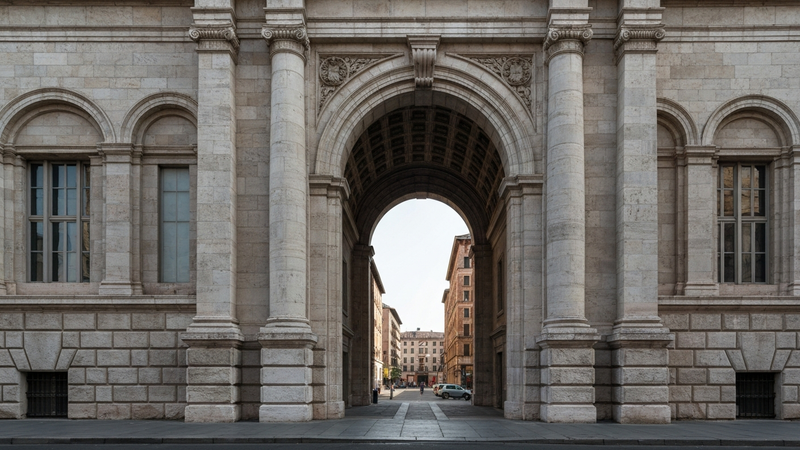
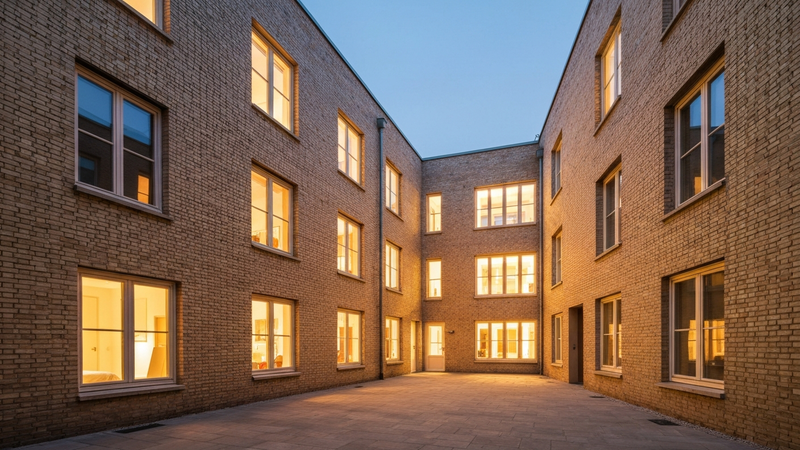
A full-block building in an Italian Renaissance manner, with the apartments arranged either to the street or to the interior court. The court is genuinely large — a quiet planted space in the middle of the West Side rather than a light well.
It is a designated landmark, which governs exterior work and carries maintenance obligations the condominium funds. The carriage gates and the courtyard are its defining features and its permanent responsibility.
Inside, the apartments are 1908 in origin: high ceilings, formal room sequences and proportions that new construction does not reproduce. A later renovation modernised systems and finishes without changing that basic geometry.
| Attribute | Detail |
|---|---|
| Address | 225 West 86th Street, Manhattan |
| Completed | 1908 |
| Form | Full block around a large interior courtyard |
| Status | Designated landmark |
| Ownership form | Condominium |
| Board approval | Right of first refusal only |
Building facts. Unit-level figures - size, exposure, charges, tax - must be obtained for the specific residence.
The location is on Google Maps here.
2. Why the Ownership Form Decides This

Roughly three quarters of Manhattan's pre-1980 apartment stock is cooperative. Cooperative boards approve every purchaser, require verified financial disclosure and frequently restrict entity and trust ownership.
A prewar condominium removes all of that: no board vote, only a right of first refusal that is almost never exercised, and non-resident and entity ownership generally accepted.
For a buyer who wants an established building rather than new construction, that narrows the field to roughly a dozen candidates city-wide, and this is among the largest of them.
Our foreign buyer guide explains why the form usually settles an international search before price is discussed.
3. The Diligence a 1908 Building Requires

The ordinary review first: audited financial statements, the reserve balance in dollars, assessment history and two years of board minutes. Those four describe the next decade better than any tour.
Then the questions specific to the age and the designation. What is landmarked, what work is anticipated on the facade, the courtyard and the systems, and how the reserve study funds it.
Where a building has been comprehensively renovated, ask what was replaced and when. A completed facade or systems programme is worth considerably more than a reserve balance of the same size.
Our building diligence guide lists every document and what each reveals.
4. Buying Here as an Overseas Purchaser
Straightforward: no board approval vote, non-resident and entity ownership accepted, subletting governed by written rules rather than by a board's discretion.
Mansion tax applies from $1 million on the whole price, reaching 2.25% between $5 and $10 million and 3.25% above $10 million, paid by the buyer at closing. Obtain common charges and property tax for the specific unit.
Settle ownership structure before contract; US estate tax reaches non-resident owners above a $60,000 exemption on US-situs assets. See our estate tax guide and buying from overseas guide.
Court-facing versus street-facing
The two are different products at the same address. Court apartments are quieter and more private with a shorter outlook; street apartments carry more light and more noise depending on which frontage they occupy.
Ask for closed sales by exposure rather than for the building as a whole, and view at an hour when Broadway is actually busy. Both are obtainable before you travel.
The Upper West Side as a place to live
The district is residential rather than commercial, with schools, food shops, the park on one side and the river on the other, and heights that stay moderate away from the avenues.
For a household living here full time that combination is the practical argument, and it is why prices in this district have moved less sharply through cycles than in more speculative areas.
Two courtyard buildings, one decision
The Belnord and the Apthorp are the only two full-block courtyard condominiums on the West Side, forty blocks apart, both from the same decade.
Compare them on total carrying cost per square foot, on what each has already replaced, and on which court you would rather look at. Those three answers settle it faster than any architectural argument.
Final Thoughts: Prewar Without the Interview
Most buildings of this quality and age in New York are cooperative, and most of those are closed to a buyer whose assets sit abroad. This one is not, which is a rarer attribute than the courtyard. What it asks in return is diligence on a 1908 capital plan — a document exercise, not a gamble.
We cover the Upper West Side on Satoshi Onodera's YouTube channel and on Instagram. If a residence here is in view, talk to our team and we will obtain the financials and the landmark obligations first. Real estate brokerage services are provided through licensed professionals.
A note on financing for a buyer abroad. Foreign national mortgages require a larger deposit and a longer underwriting period than domestic ones, and lenders assess older converted buildings with more care than new towers.
Confirm early that your lender is comfortable with the building itself rather than only with you as a borrower. That question takes a day to answer in advance and weeks to resolve after a contract is signed.
One last point on supply. No further prewar buildings will be constructed, the existing ones are protected by designation, and the handful that are condominium cannot be added to. Whatever this building is worth today, the supply of anything comparable is fixed permanently at its current number.
One point applies to every purchase of this kind made from another country. The document work — financial statements, reserve balance, assessment history, board minutes and the governing agreements — can be completed in full before anyone travels, and it is what actually determines whether a building is sound.
The physical inspection is the only part that requires presence, and even that can be run as a live walkthrough with dimensions and light conditions recorded on camera. Buyers who reverse the order, travelling first and reading afterwards, routinely lose weeks and occasionally lose a deposit on a building the documents would have ruled out in an afternoon.
Reinvent NY provides business consulting, operational support, and coordination services. Legal advice and immigration filings are handled by independent licensed attorneys. Real estate services are provided through licensed professionals and applicable brokerage relationships. This article is for informational purposes only and does not constitute legal or investment advice.
More buildings worth knowing: 100 Eleventh Avenue, 111 West 57th Street, 130 William. The full set is indexed under New York building profiles.

Satoshi Onodera
Founder & CEO, Reinvent NY Inc.
Founded Reinvent NY in 2024. Providing relocation support from all over the world to America.
Ready to Get Started?
Our team in New York is ready to help with your visa, real estate, or relocation needs.
Schedule a ConsultationFrequently Asked Questions
Where is the Belnord?
225 West 86th Street, filling the block between Broadway and Amsterdam Avenue on the Upper West Side. The location is on [Google Maps](https://maps.google.com/?q=225+West+86th+Street+New+York).
When was it built?
It was completed in 1908, in an Italian Renaissance manner, and is a designated landmark.
What is unusual about the plan?
It occupies a full city block around a large interior courtyard entered through arched carriage gates — a form Manhattan produced only a handful of times.
Is it a co-op or a condominium?
It is a condominium, which for a building of this age and quality is rare and is the decisive fact for an international buyer.
Can a non-resident buy here?
Yes. As a condominium there is no board approval vote, and non-resident and entity ownership are generally accepted.
How does it compare with the Apthorp?
Both are full-block courtyard buildings of the same period on the Upper West Side, and both are condominium. They differ in position, courtyard scale and how each was renovated.
What should I confirm first?
The reserve balance and capital plan for a 1908 structure, landmark obligations, assessment history, board minutes, and the actual charges for the specific residence.
Real Estate Guides & Data
More guides
- Buying Your Office: Commercial Condos for Founders
- The US Closing Timeline: Attorney States vs Escrow States
- NYC Contract Deposits: The 10% Between Offer and Close
- When a Property Owner Dies: The Family's First Steps
- Education-Adjacent Buying: Schools as Property Strategy
- What You Need for a First New York Purchase
Related Articles
Denver Real Estate Market 2026: Prices, Rents and Yields
Denver home values in 2026: a $538,992 typical value after a 3.4% annual decline, $1,877 rents, a 4.18% gross yield, and how Colorado's other cities compare.
The Ansonia: A 1904 Beaux-Arts Hotel, Now Condominium
The Ansonia's 1904 Beaux-Arts pile on Broadway converted to condominium. Thick walls, turrets and no board vote — what to confirm before buying.
The Puck Building: Penthouses on an 1885 Landmark
The Puck Building carried penthouses added above an 1885 Romanesque landmark in Nolita. What that produces for a buyer, and what to confirm first.
Seattle Real Estate Market 2026: Prices, Rents and Yields
Seattle home values in 2026: an $856,052 typical value, $2,224 rents and a 3.12% gross yield, plus where Tacoma, Spokane and Vancouver WA offer better numbers.