Seattle Real Estate Market 2026: Prices, Rents and Yields
Seattle is what a market looks like after the boom moves out. Zillow's typical city home value of $856,052 is down 2.2% in a year, five-year growth is 4% — barely a tenth of what the 2010s delivered — and the gross rental yield of 3.12% is one of the lowest of any large US metro.
Yet Washington remains one of the few no-income-tax states with a deep, high-wage employment base. In this article, we'll look at where the numbers stand, where in the state the math actually works, and how international buyers finance a purchase.
1. Where Seattle Prices Stand in 2026
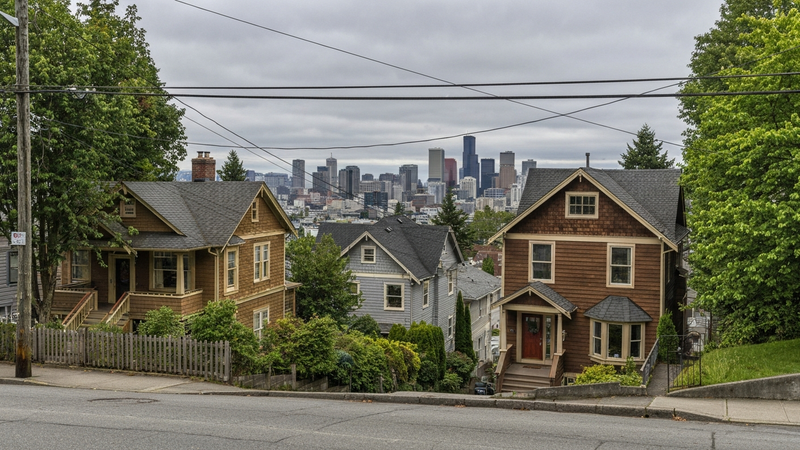
The city's correction has been shallow but persistent: -2.2% over the past year, following essentially flat years since 2022. Statewide values are down 0.6% to $603,303, though the ten-year picture — +91.8% — shows how much appreciation is already banked in.
The spread inside the state is wide. Everett, north of the city, carries a $654,227 typical value on the strength of aerospace employment. Spokane, on the eastern border, remains the value entry at $403,557.
| City | Typical value | 1-yr | 5-yr | Gross yield |
|---|---|---|---|---|
| Seattle | $856,052 | -2.2% | +4.0% | 3.12% |
| Everett | $654,227 | -1.5% | +18.4% | 3.57% |
| Vancouver | $511,271 | -0.5% | +15.4% | 4.27% |
| Tacoma | $498,063 | -0.4% | +9.3% | 4.21% |
| Spokane | $403,557 | -0.3% | +12.1% | 4.45% |
Zillow ZHVI and ZORI, mid-2026. Gross yield is annualized rent divided by typical value, before all costs.
Full state-level figures, including the ten-year series, are on our Washington market page, updated from the same Zillow dataset.
How the last five years set up 2026
Washington's ten-year gain of 91.8% is the second act of a two-act story: nearly all of it was earned by 2022. Since then the state has traded sideways, and Seattle proper has done slightly worse than sideways — the +4.0% five-year figure includes a peak-to-now decline the city has not yet fully reclaimed.
That history matters for underwriting. A buyer in 2026 is not paying for momentum, because there is none; they are paying for the option that a supply-constrained, high-wage metro reverts to growth. Options have value, but they should be priced as options — which argues for negotiating hard rather than chasing.
2. Rents, Yields and the Income Problem

Seattle rents at $2,224 have not kept pace with what owners paid for the buildings. At 3.12% gross — before property tax, insurance, management and maintenance — a leveraged Seattle rental frequently runs cash-flow negative at 2026 interest rates.
Washington's compensation is on the tax line: no state personal income tax, which matters most to owners in high brackets elsewhere. Tacoma, Vancouver and Spokane push gross yields above 4.2%, which is where the state's rental math starts to function.
Before comparing offers, work through the difference between gross, net and cash-on-cash in our rental yield guide — Seattle is precisely the market where the gap between those three numbers decides the deal.
A worked example at the citywide numbers
At the typical value of $856,052 and $2,224 median rent, a fully occupied Seattle rental collects $26,688 a year — the 3.12% gross. Deduct property tax per the county assessor, insurance, management at 8-10%, maintenance and a month of vacancy, and the unlevered net lands near $15,000-$18,000, roughly 1.8-2.1% on the price.
Add 2026 mortgage rates on a 70% loan and the cash flow turns negative before appreciation. The same exercise in Spokane — $403,557 value, $1,498 rent — nets closer to 2.7-3.0% unlevered, which is why the state's investable story has migrated away from its flagship city.
3. Financing and Structure for International Buyers

There is no restriction on foreign ownership of Washington real estate. Without a US credit file, lenders offer foreign national and DSCR programs at 25-30% down; DSCR underwriting is harder to clear in Seattle proper because the rent-to-price ratio is thin, and correspondingly easier in Tacoma or Spokane.
Washington also levies a graduated real estate excise tax on sellers at transfer, which affects your exit math more than your entry. Factor it into hold-period modelling, and confirm current brackets with the state Department of Revenue at the time of sale.
Entity choice — personal name, LLC or corporation — determines liability, estate exposure and filing burden. The decision framework is in our holding structures guide.
The purchase timeline from abroad
Washington closes through escrow rather than an attorney-led process: a neutral escrow company holds funds and documents, title insurance clears the record, and a financed purchase typically runs 30-45 days from mutual acceptance. Cash purchases can close in two to three weeks.
Remote closing is routine — powers of attorney and remote online notarization are both accepted in practice, and funds arrive by international wire. The step-by-step mechanics for an overseas buyer are in our guide to buying without flying in.
4. The Case Against Seattle — and the Rebuttal

The bear case writes itself: four years of flat-to-falling prices, a 3.12% yield that loses to Treasury bills, and remote work loosening the tie between tech salaries and city addresses. Some argue Seattle is a 2010s story that already ended.
The rebuttal is selective, not general. City-core condos remain hard to justify on income. But the metro still adds high-wage jobs, supply of buildable land is constrained by water and mountains, and secondary cities at 4.2-4.5% gross with sub-$520,000 entries are a different asset than an $856,052 Seattle house. The state is more investable than its flagship city.
What would change our read: two consecutive quarters of rent growth above 3% annualized, office-to-residential conversions moving from announcement to permit at scale, or the spread between Seattle and Tacoma yields narrowing below half a point. Any of those would signal the city core re-pricing toward its suburbs rather than away from them — and would move Seattle proper from hold to accumulate in our framework.
Our metro comparison sets Seattle beside nineteen other markets on identical measures if you want the cross-market view before committing.
Final Thoughts: Who Seattle Fits

Seattle in 2026 fits the long-horizon buyer purchasing below the 2022 peak in a no-income-tax state — and accepts negative near-term carry as the price of the entry point. Income-first investors should look at Tacoma, Vancouver or Spokane, where the same state tax advantages come with a workable rent-to-price ratio.
We help international buyers underwrite specific properties, arrange foreign national financing and manage the closing, with brokerage services provided through licensed professionals. Contact our team to run the numbers before you commit to any of these markets.
Reinvent NY provides business consulting, operational support, and coordination services. Legal advice and immigration filings are handled by independent licensed attorneys. Real estate services are provided through licensed professionals and applicable brokerage relationships. This article is for informational purposes only and does not constitute legal or investment advice.
More market reports: Austin Real Estate Market 2026, California Real Estate Market 2026, Chicago Real Estate 2026. The full set is indexed under market data for all 51 states.

Satoshi Onodera
Founder & CEO, Reinvent NY Inc.
Founded Reinvent NY in 2019. Providing relocation support from all over the world to America.
Ready to Get Started?
Our team in New York is ready to help with your visa, real estate, or relocation needs.
Schedule a ConsultationFrequently Asked Questions
How much does a home cost in Seattle in 2026?
Zillow's typical home value for the city of Seattle is $856,052 as of mid-2026, down 2.2% over the past year. Washington state overall sits at $603,303.
Why are Seattle rental yields so low?
Prices ran far ahead of rents during the 2016-2022 tech expansion. At $2,224 median asking rent against an $856,052 typical value, gross yield is about 3.12% — among the lowest of large US metros.
Does Washington have a state income tax?
No. Washington levies no personal state income tax, which improves after-tax rental income for many owners. Property is still taxed locally — confirm rates with the county assessor for any specific parcel.
Where in Washington are yields better than Seattle?
Spokane runs about 4.45% gross, Vancouver 4.27% and Tacoma 4.21% on Zillow mid-2026 figures — roughly a full point higher than Seattle, at entry prices around half the city's.
Can a foreign buyer purchase Seattle property?
Yes. Washington has no citizenship requirement for ownership. Buyers without US credit typically use foreign national or DSCR loans with 25-30% down payments.
Is 2026 a good time to buy in Seattle?
Values are 2.2% below last year and five-year growth is just 4%, so the entry point is softer than any time since 2019. Whether that is opportunity or a warning depends on your horizon — the income case remains thin at current rents.
Real Estate Guides & Data
More guides
- Commercial vs Residential: Two Investment Grammars
- Cost Segregation: Accelerating US Property Depreciation
- Divorce and NY Real Estate: Dividing the Apartment
- Exit Planning Five Years Out: Selling Starts Early
- Furnished and Corporate Rentals: The 30-Day-Plus Market
- How to Hold US Property: Personal, LLC or Corporation
Related Articles
The Belnord: A 1908 Courtyard Block on the West Side
The Belnord wraps a full block around a private courtyard and is condominium. Prewar rooms without a board vote, and what to confirm before buying.
The Puck Building: Penthouses on an 1885 Landmark
The Puck Building carried penthouses added above an 1885 Romanesque landmark in Nolita. What that produces for a buyer, and what to confirm first.
The Sherry-Netherland: An Apartment Hotel Since 1927
The Sherry-Netherland has stood at Fifth Avenue and 59th Street since 1927 as a cooperative apartment hotel. Recorded sales since 2023 and the median price.
Boston Real Estate Market 2026: Prices, Rents and Yields
Where Boston home values stand in 2026: a $788,881 typical value, $3,469 median asking rents, a 5.28% gross yield, and how the metro compares for investors.