Denver Real Estate Market 2026: Prices, Rents and Yields
Denver spent a decade as one of America's boomtowns. In 2026 it is something more useful to a disciplined buyer: a correcting market. The typical home value of $538,992 is down 3.4% in a year, and five-year growth of 1.0% means prices today sit almost exactly where they stood in 2021.
Flat is not the same as broken. Let's examine what the numbers say, where Colorado's yields actually clear, and how an international buyer approaches a market in mid-correction.
1. Where Denver Prices Stand in 2026

The city's -3.4% year-over-year decline is steeper than the state's -2.0%, and steeper than nearly every metro we track outside Texas and Florida. Aurora, Denver's largest eastern suburb, is down 3.5% on the year.
The northern tier tells a different story. Fort Collins, anchored by a university and stable public employment, has grown 14.0% over five years — the state's standout — while Colorado Springs at $450,254 remains the affordability release valve.
| City | Typical value | 1-yr | 5-yr | Gross yield |
|---|---|---|---|---|
| Denver | $538,992 | -3.4% | +1.0% | 4.18% |
| Aurora | $462,424 | -3.5% | +5.2% | 4.56% |
| Colorado Springs | $450,254 | -1.8% | +6.8% | 4.63% |
| Fort Collins | $569,102 | -1.0% | +14.0% | 4.09% |
| Lakewood | $572,759 | -2.4% | +6.6% | 3.80% |
Zillow ZHVI and ZORI, mid-2026. Gross yield is annualized rent divided by typical value, before all costs.
The full Colorado series, including ten years of state history, is on our Colorado market page.
How the last five years set up 2026
Colorado's decade gain of 65.0% front-loaded almost everything into 2016-2021. Denver's five-year figure of +1.0% means a 2021 buyer at today's price has essentially round-tripped — and that flat stretch happened while the metro kept delivering new apartment supply that had been permitted in the boom.
The setup for 2026 is therefore a genuine test of absorption: supply deliveries are now past their peak while in-migration continues at a reduced but positive rate. Markets that digest supply with flat prices rather than falling ones typically resolve upward; Denver's -3.4% says the digestion is not finished yet.
2. Rents, Yields and the Supply Question
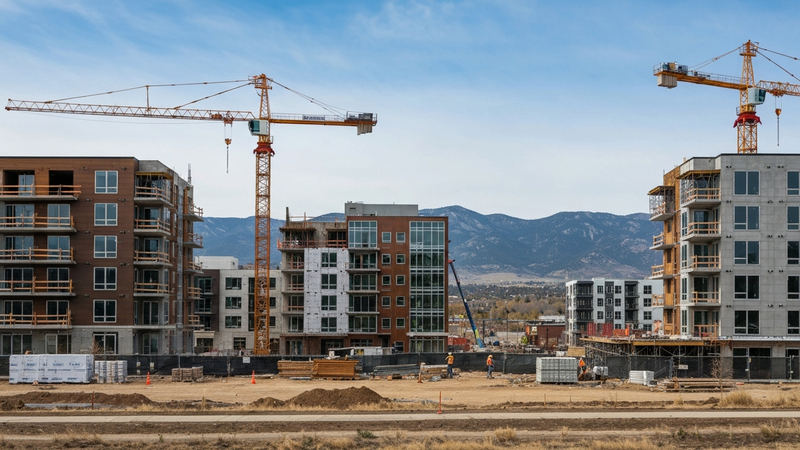
Denver's correction is a supply story as much as a demand one. The metro permitted apartments aggressively through the early 2020s, and that pipeline has kept rents in check: $1,877 median asking, for a 4.18% gross yield. Renters have choices, so underwriting should assume real vacancy and concession periods, not permanent full occupancy.
For income buyers, the suburbs out-earn the core. Aurora and Colorado Springs both clear 4.5% gross at entry prices $75,000-$90,000 below Denver's, and both lean on employment bases — defense, healthcare, logistics — less cyclical than downtown office.
Gross-to-net mechanics — taxes, insurance, management, reserves — are covered step by step in our rental yield guide. Colorado property taxes are set locally, so verify the specific parcel with the county assessor.
A worked example at the citywide numbers
At Denver's $538,992 typical value and $1,877 median rent, full occupancy collects $22,524 a year — the 4.18% gross. Subtract property tax, insurance, 8-10% management, maintenance and a month of vacancy plus a concession, and the unlevered net settles near $13,000-$15,500, roughly 2.4-2.9% on the price.
Run the identical stack in Colorado Springs — $450,254 value, $1,739 rent — and the net lands closer to 2.9-3.3%. Neither is a cash-flow feast at 2026 rates, which is why the Denver case rests on buying the correction, not on the income statement alone.
3. Financing and Structure for International Buyers

Colorado places no restriction on foreign ownership. Buyers without a US credit file generally use foreign national or DSCR loans at 25-30% down; in a correcting market, DSCR lenders will stress-test the rent assumptions, so bring the comparable leases, not the listing rents.
A correction is also when inspection discipline pays. Denver's housing stock spans 1900s brick to 2020s slab-on-grade, and sellers in a slow market defer maintenance. Budget the inspection seriously — our home inspection guide covers what a US inspection does and does not check.
Ownership structure — personal name, LLC or corporation — should be settled before contract. The trade-offs are in our holding structures guide.
The purchase timeline from abroad
Colorado closes through title companies on standardized state contract forms, and a financed purchase typically runs 30-45 days from contract to keys. The state's contract gives buyers clearly dated objection deadlines — inspection, appraisal, loan — that function as clean exit ramps if diligence turns up problems.
The entire sequence works remotely: power of attorney or remote notarization for signatures, international wire for funds, delegated walkthrough. The overseas mechanics are the same as in our guide to buying without flying in.
4. The Case Against Denver — and the Rebuttal

The bear case: five years of nothing. An investor who bought in 2021 has watched Sun Belt metros compound while Denver went sideways, and the current 3.4% annual decline suggests the bottom is not confirmed. Some argue the Colorado premium was a zero-interest-rate artifact.
The rebuttal rests on what corrections produce: entry prices. Denver still holds the Mountain West's largest employment base, its airport hub and its university pipeline; none of that left. Buying a structurally sound market at 2021 prices with negotiating leverage is historically how patient money gets paid — provided the hold horizon is five years or more, not two.
What would confirm the bottom: apartment deliveries falling below the metro's five-year absorption average, the year-over-year decline flattening inside one percent, and days-on-market stabilizing through a spring selling season. We would treat two of those three as the signal to move from watching Denver to bidding it — and all three as confirmation the correction has finished its work.
For the cross-market view, our metro comparison sets Denver against nineteen other markets on the same measures.
Final Thoughts: Who Denver Fits

Denver in 2026 fits the patient buyer who wants a major-metro asset at a discount to its recent past and can carry it through an unconfirmed bottom. Income-first investors should price Aurora and Colorado Springs first; growth-first buyers should look at Fort Collins.
Genuine corrections in supply-constrained major metros are rare events, and Denver's mountains have not moved an inch. The buyers who do best in this market will be the ones underwriting it now, while the sellers are still negotiating.
We support international buyers from underwriting through closing, with brokerage services provided through licensed professionals. If Colorado is on your list, contact our team and we will test the numbers on the specific property before you commit.
Reinvent NY provides business consulting, operational support, and coordination services. Legal advice and immigration filings are handled by independent licensed attorneys. Real estate services are provided through licensed professionals and applicable brokerage relationships. This article is for informational purposes only and does not constitute legal or investment advice.
More market reports: Austin Real Estate Market 2026, California Real Estate Market 2026, Chicago Real Estate 2026. The full set is indexed under market data for all 51 states.

Satoshi Onodera
Founder & CEO, Reinvent NY Inc.
Founded Reinvent NY in 2019. Providing relocation support from all over the world to America.
Ready to Get Started?
Our team in New York is ready to help with your visa, real estate, or relocation needs.
Schedule a ConsultationFrequently Asked Questions
How much does a home cost in Denver in 2026?
Zillow's typical home value for Denver is $538,992 as of mid-2026, down 3.4% over the past year — one of the sharper declines among large US metros. Colorado statewide sits at $543,435, down 2.0%.
Why are Denver prices falling?
Denver ran hot through 2021 and has been digesting it since: five-year growth is just 1.0%, meaning values are roughly where they stood in 2021 while supply of new apartments and homes kept arriving.
What is the rental yield in Denver?
At $1,877 median asking rent against a $538,992 typical value, gross yield is about 4.18% before taxes, insurance and management. Colorado Springs and Aurora run higher, at 4.63% and 4.56% respectively.
Can a non-US resident buy property in Colorado?
Yes. Colorado imposes no citizenship or residency requirement on ownership. Buyers without US credit history typically use foreign national or DSCR loans with 25-30% down.
Is 2026 a buyer's market in Denver?
By most measures yes: values 3.4% below last year, inventory elevated, and sellers negotiating. The open question is timing — the five-year flat stretch shows corrections here can run long.
Which Colorado city is best for investors?
It depends on the goal. Denver has the deepest tenant pool and best liquidity. Colorado Springs offers a higher yield at a $450,254 entry. Fort Collins has posted the strongest five-year growth at 14.0%.
Real Estate Guides & Data
More guides
- Closing Costs in New York: Every Line, Itemised
- Condo vs Co-op in New York: What Actually Differs
- Borrowing Across Currencies: Debt as an FX Instrument
- The Owner's Document Glossary: Every Paper, Explained
- FIRPTA Withholding: Selling US Property as a Foreign Person
- Gifting US Property: Moving Real Estate Between Family
Related Articles
The Eldorado: Art Deco Twin Towers on the Park
The Eldorado closed the Central Park West skyline in 1931 with Art Deco twin towers. See the sales the city has recorded there since 2023 and the median price.
Atlanta Real Estate Market 2026: Prices, Yields and Suburbs
Atlanta home values in 2026: a $387,146 typical value, $1,911 rents and a 5.92% gross yield — plus how Marietta, Lawrenceville and Savannah compare for buyers.
The Ansonia: A 1904 Beaux-Arts Hotel, Now Condominium
The Ansonia's 1904 Beaux-Arts pile on Broadway converted to condominium. See the sales the city has recorded there since 2023 and the median price.
The Belnord: A 1908 Courtyard Block on the West Side
The Belnord wraps a full block around a private courtyard and is condominium. Prewar rooms without a board vote, and what to confirm before buying.