Atlanta Real Estate Market 2026: Prices, Yields and Suburbs
Atlanta is where the yield hunters went after 2020, and the numbers explain why they stayed. The city's typical home value of $387,146 — half of Boston, a third of Seattle — collects $1,911 in median asking rent, a gross yield of 5.92% that leads nearly every major US metro.
The past year has taken some froth off: values are down 2.9%. In this article, we'll look at where metro Atlanta stands, which suburbs carry the numbers, and what international buyers should check before wiring a deposit.
1. Where Atlanta Prices Stand in 2026

The city is down 2.9% year over year, and the cooling is broad: Lawrenceville -3.0%, Savannah -2.9%, Cumming -2.6%, Marietta -1.6%. What stands out is the five-year base underneath — suburban Atlanta compounded 25-36% since 2021 while the city core added just 5.3%.
That split reflects where the growth actually happened: households and employers moved outward along the northern arc, and the price data followed.
| City | Typical value | 1-yr | 5-yr | Gross yield |
|---|---|---|---|---|
| Atlanta | $387,146 | -2.9% | +5.3% | 5.92% |
| Lawrenceville | $383,935 | -3.0% | +25.9% | 5.88% |
| Marietta | $480,648 | -1.6% | +25.7% | 4.29% |
| Cumming | $605,713 | -2.6% | +35.8% | 4.58% |
| Savannah | $326,616 | -2.9% | +37.5% | 6.64% |
Zillow ZHVI and ZORI, mid-2026. Gross yield is annualized rent divided by typical value, before all costs.
Georgia's full state series is on our Georgia market page, drawn from the same Zillow dataset and updated with each refresh.
How the last five years set up 2026
Georgia's decade gain of 98.0% nearly doubled the state's housing values, yet the city of Atlanta captured surprisingly little of the final act — 5.3% in five years while its own suburbs ran 25-36%. Institutional buyers concentrated on suburban single-family stock, and the price data maps their footprint almost exactly.
For a 2026 entrant this is useful asymmetry. The suburban corridors carry the momentum and the competition; the city core carries neither, which is precisely why its yield is higher. Buying where the institutions are not has historically been the individual investor's structural edge in this metro.
2. Rents, Yields and the Institutional Factor
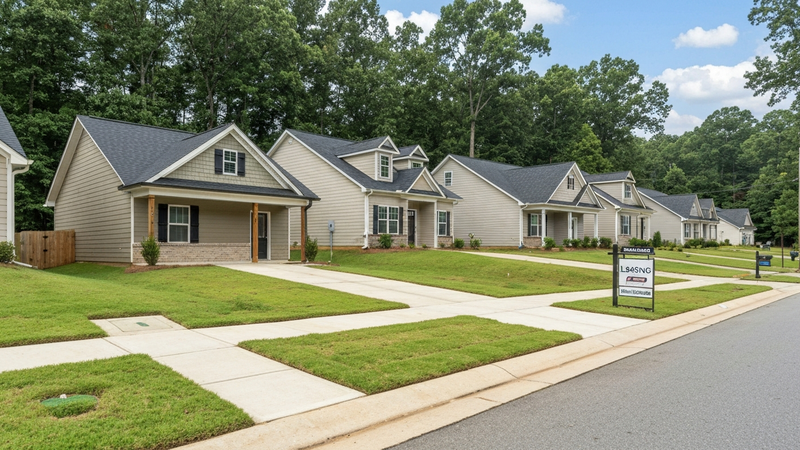
Atlanta's near-6% gross yield is the metro's calling card, but it comes with a market structure to understand: large institutional landlords own tens of thousands of single-family rentals here. They set professionalized rent levels, respond fast to softness, and compete for the same tenants an individual owner wants.
The practical effect cuts both ways. Rent comparables are transparent and leasing infrastructure is excellent; at the same time, concessions spread quickly when supply loosens, as it has this year. Model vacancy honestly rather than assuming the asking rent.
To convert 5.92% gross into a net and cash-on-cash figure, follow the sequence in our rental yield guide. Georgia property taxes vary by county and school district — verify the parcel's actual bill with the county assessor.
A worked example at the citywide numbers
At the $387,146 typical value and $1,911 median rent, full occupancy collects $22,932 a year — the 5.92% gross. Deduct property tax, insurance, 8-10% management, maintenance and six weeks of combined vacancy and concession, and the unlevered net lands around $14,000-$16,500, or 3.6-4.3% on the price.
That spread over financing costs is what makes Atlanta one of the few major metros where a 70% loan can still pencil to positive cash flow in 2026 — provided the rent assumption comes from executed leases in the submarket, not from the listing.
3. Financing and Structure for International Buyers

Metro Atlanta residential purchases carry no citizenship requirement. Buyers without US credit typically use foreign national or DSCR loans at 25-30% down, and Atlanta is one of the easiest US metros to clear DSCR underwriting because the rent-to-price ratio is strong.
One Georgia note: the state has restricted certain agricultural land acquisitions by some foreign entities. Standard residential and condo purchases in metro Atlanta are not the target of those rules, but if a deal involves acreage, confirm treatment with a Georgia real estate attorney before contract.
Most overseas owners here hold through an LLC for liability and estate reasons — the decision framework is in our holding structures guide, and the financing specifics are in our foreign national mortgage guide.
The purchase timeline from abroad
Georgia is an attorney-closing state: a closing attorney conducts the settlement and disburses funds, and a financed purchase typically runs 30-45 days from binding agreement. Due diligence periods are negotiated per contract and give the buyer a defined window to exit on inspection findings.
Overseas execution is standard practice — power of attorney or remote notarization for documents, international wire for funds, and a delegated final walkthrough. The full remote sequence is described in our guide to buying without flying in.
4. The Case Against Atlanta — and the Rebuttal

The bear case: everyone already knows. A decade of institutional buying has arbitraged the easy yield, new-build supply on the metro's edge keeps a lid on rent growth, and this year's -2.9% shows the market is not immune to rates. Some argue the Sun Belt trade is crowded and late.
The rebuttal is that crowded is not the same as wrong. The yield spread over coastal metros — roughly two full points over Seattle — remains after a decade of institutional presence, because it is underwritten by land availability and in-migration, not by a temporary anomaly. Atlanta's risk is mediocrity of appreciation, not failure of income.
What we watch from here: institutional acquisition volumes turning back up after this year's pause, the concession rate on new suburban leases, and whether Savannah's port-driven run extends beyond its 37.5% five-year gain. Rising institutional buying with falling concessions would mark the end of the current soft patch — historically the metro's best entry window closes quickly once both turn.
Set Atlanta against nineteen other metros on identical measures in our metro comparison before deciding where it ranks for your goals.
Final Thoughts: Who Atlanta Fits

Atlanta fits the income-first investor who wants big-metro liquidity with small-metro entry prices, and accepts institutional competition as the cost of a transparent, liquid rental market. Savannah is the yield outlier at 6.64%; the northern suburbs are the balanced play.
The 2026 entry conditions — prices 3% off their peak, yields near 6%, and the institutional bid temporarily quiet — are better than any year since 2019. Windows like this close without announcement.
We support international buyers through underwriting, financing introductions and closing, with brokerage services provided through licensed professionals. Contact our team to pressure-test a specific Atlanta deal before you commit.
Reinvent NY provides business consulting, operational support, and coordination services. Legal advice and immigration filings are handled by independent licensed attorneys. Real estate services are provided through licensed professionals and applicable brokerage relationships. This article is for informational purposes only and does not constitute legal or investment advice.
More market reports: Austin Real Estate Market 2026, California Real Estate Market 2026, Chicago Real Estate 2026. The full set is indexed under market data for all 51 states.

Satoshi Onodera
Founder & CEO, Reinvent NY Inc.
Founded Reinvent NY in 2019. Providing relocation support from all over the world to America.
Ready to Get Started?
Our team in New York is ready to help with your visa, real estate, or relocation needs.
Schedule a ConsultationFrequently Asked Questions
How much does a home cost in Atlanta in 2026?
Zillow's typical home value for the city of Atlanta is $387,146 as of mid-2026, down 2.9% over the past year. Georgia statewide sits at $335,358.
What rental yield does Atlanta offer?
About 5.92% gross — $1,911 median asking rent against a $387,146 typical value, before taxes, insurance and management. That is among the strongest of any major US metro in 2026.
Are Atlanta home prices dropping?
Yes, modestly: the city is down 2.9% year over year, and most of its suburbs are down 1.5-3.0%. Five-year growth remains strongly positive everywhere except the city core.
Can a non-US resident buy property in Georgia?
Yes, for residential property in metro Atlanta there is no citizenship requirement. Georgia does restrict certain agricultural land acquisitions by some foreign entities, which does not affect typical residential purchases — confirm specifics with a Georgia attorney.
Where do investors buy in metro Atlanta?
Inside the city for tenant depth and liquidity, Lawrenceville and the Gwinnett County corridor for yield near 5.9%, Marietta for established suburban stock, and Savannah — a separate coastal market — for the state's highest gross yield at 6.64%.
Why is Atlanta popular with rental investors?
The combination is rare: a top-ten metro economy, entry prices under $400,000, and gross yields near 6%. Institutional buyers have operated at scale here for a decade for the same reasons.
Real Estate Guides & Data
More guides
- The Seasonal Owner's Playbook: Months Away, Done Right
- Sending Money to the US for a Property Purchase
- NYC Tax Abatements: What Happens When They Expire
- Buying a NYC Townhouse: One Building, All Yours
- US Property Tax for Overseas Owners: Why Averages Mislead
- US Property Ownership Myths: What Buying Does Not Do
Related Articles
River House: The 1931 Building at the End of 52nd Street
River House was built in 1931 with a private courtyard on the East River. See the sales the city has recorded there since 2023 and the median price.
The Eldorado: Art Deco Twin Towers on the Park
The Eldorado closed the Central Park West skyline in 1931 with Art Deco twin towers. See the sales the city has recorded there since 2023 and the median price.
Denver Real Estate Market 2026: Prices, Rents and Yields
Denver home values in 2026: a $538,992 typical value after a 3.4% annual decline, $1,877 rents, a 4.18% gross yield, and how Colorado's other cities compare.
The Ansonia: A 1904 Beaux-Arts Hotel, Now Condominium
The Ansonia's 1904 Beaux-Arts pile on Broadway converted to condominium. See the sales the city has recorded there since 2023 and the median price.