Co-op Financial Statements: What Buyers Must Check
A co-op board can raise your maintenance 18 percent in a single vote, and you will have no say in it. Whether that happens is largely decided by documents you can read before you sign — and that most buyers never open.
Co-op financial statements are the closest thing New York offers to an audited disclosure of what a building will cost you over the next decade. They are handed to buyers as a formality and, too often, treated as one.
In this article, we'll walk through the documents to request, the six numbers to pull from them, and the specific patterns — a 2027 balloon, a six-week reserve, a sponsor still holding a third of the shares — that predict a maintenance increase long before it is announced.
The Three Documents to Request

Ask for three things, and do not accept a summary in place of any of them: the audited annual financial statement for the last three fiscal years, the current operating budget, and board meeting minutes covering the last 12 to 24 months.
The audited statement is prepared by an independent CPA and is the only one of the three carrying an outside signature. It holds the balance sheet, the income statement, the cash flow statement, and — most usefully — the notes, where underlying mortgage terms and pending litigation are disclosed.
The budget tells you what the board intends to spend next year. The minutes tell you what the board is actually worried about, and capital projects surface there months before they appear as a budget line or an assessment letter.
Read the statements as a three-year series rather than a snapshot. A single year tells you almost nothing; three years tells you whether operating costs are outrunning maintenance income, whether the reserve is being built or drained, and whether the board treats the budget as a planning document.
Your attorney reviews all three during due diligence, along with the offering plan and its amendments. This is the same file the co-op board package sits on top of, and the financial review should be finished before that package goes out.
Start With the Underlying Mortgage

A co-op is a corporation, and most of them carry a building-wide mortgage. Three facts about it drive maintenance more than anything else on the income statement: the outstanding balance, the interest rate, and the maturity date.
All three sit in the notes to the financial statement. A building holding $12 million at 3.6 percent maturing in 2027 is a fundamentally different investment from the same building at 3.6 percent maturing in 2036, even though this year's statements look identical.
Most co-op underlying mortgages are interest-only or lightly amortizing, with a balloon payment at maturity. When that balloon comes due the board refinances at whatever the market offers, and a loan written in the low 3s refinanced into the 6s can roughly double annual debt service. There is only one place that money comes from.
Ask the managing agent three direct questions: what is the maturity date, is the loan interest-only, and has the board modeled the maintenance impact of a refinancing. A board that has run the analysis will hand it to you. A board that has not has also told you something.
The Six Numbers, and What Good Looks Like

Six figures carry most of the signal in a co-op's financials. Pull each one, write it down, and compare across three consecutive years rather than reading a single statement in isolation.
| Number to pull | Where it lives | What generally looks healthy |
|---|---|---|
| Underlying mortgage balance, rate, maturity | Notes to the financial statement | Maturity 5+ years out, or a documented refinancing plan |
| Reserve fund balance | Balance sheet, cash and investments | Roughly three months of operating expenses or more |
| Operating surplus or deficit | Income statement, three-year trend | Small surplus or breakeven; repeated deficits are the warning |
| Sponsor-held shares | Offering plan amendments, co-op questionnaire | Typically under about 10 percent of total shares |
| Flip tax as a share of income | Income statement | A modest share; a budget balanced on it is fragile |
| Maintenance increase history | Board minutes and prior budgets | Steady 2 to 4 percent a year, not flat years then a spike |
These are working guidelines rather than fixed lender rules; thresholds vary by building and by lender.
Sponsor ownership deserves particular attention. Many lenders want the sponsor holding under roughly 10 percent of shares and the building above 50 percent owner-occupancy. These are typical guidelines rather than universal rules, but they can make an otherwise excellent apartment difficult to finance.
Reliance on the flip tax is the subtler risk. Transfer fee revenue is lumpy and tied entirely to turnover, so a budget balanced on last year's sales volume balances on nothing durable. In a slow year the shortfall becomes a maintenance increase.
However, some argue this level of review is theater — that a buyer has no leverage to change what the documents reveal and will proceed anyway. That is half right. You rarely renegotiate a co-op price on the strength of the financials.
What you do instead is price the risk or walk away. A building carrying a 2027 balloon and six weeks of reserves is not the same asset as the one across the street at an identical price per share, and knowing which one you are buying is the entire purpose of the exercise.
Capital Projects and the Land-Lease Exception
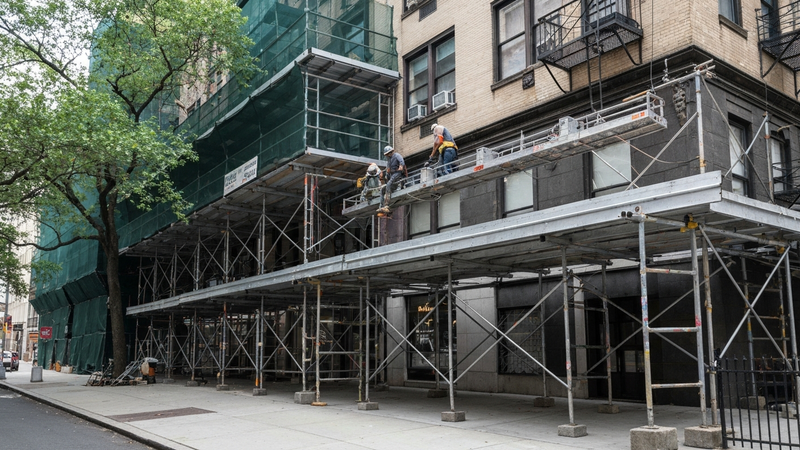
Read the minutes for five words: facade, elevator, roof, boiler, and assessment. Local Law 11, the facade inspection program run by the NYC Department of Buildings, requires buildings taller than six stories to file an inspection every five years, and a full repair cycle on a large prewar building routinely reaches seven figures.
Elevator modernization and roof replacement are the other two projects large enough to force an assessment on their own. Where any of them appear in the minutes without a named funding source, the funding source is you.
The maintenance history in the minutes is the cheapest diagnostic available. A building raising maintenance 2 to 4 percent every year is funding itself in real time. A building that held maintenance flat from 2020 through 2024 has not solved anything — it has accumulated a bill and chosen not to name it yet.
Land-lease co-ops are a separate risk category
A land-lease co-op does not own the ground beneath the building. The corporation leases it, and the ground rent resets on a schedule written decades ago, often against current land value. In several well-documented Manhattan cases, a single reset has multiplied maintenance and cut resale values sharply.
| Question | Fee-simple co-op | Land-lease co-op |
|---|---|---|
| Who owns the land | The co-op corporation | A third-party landowner |
| Recurring reset risk | None | Ground rent resets on a fixed schedule |
| Financing | Standard co-op lending | Fewer lenders; remaining lease term drives eligibility |
| Resale pricing | Set by the market | Discounted against the next reset date |
A visible discount on a land-lease building is compensation for a defined risk, not a bargain.
These buildings can still work for a buyer with a specific horizon, but they should never be underwritten as ordinary co-ops, and the reset date and formula belong in your analysis before an offer. A New York real estate attorney should read that lease line by line. Our condo versus co-op guide covers where each ownership structure fits.
Final Thoughts

A co-op purchase is an equity investment in a small corporation that happens to come with an apartment attached. The financial statements are the only place that corporation describes itself under an auditor's signature.
Give your attorney the full package early enough for it to matter: three years of audited statements, the current budget, and two years of minutes. Ask for a written summary of the underlying mortgage terms and the reserve position before the contract is signed.
Then translate what you find into a number. If the underlying mortgage matures inside your expected hold, model the refinancing at a materially higher rate and carry the resulting maintenance into your budget rather than assuming today's figure holds.
Most buildings pass this review comfortably. The ones that do not tend to fail on a single number visible months in advance — a balloon nobody planned for, a reserve nobody funded, a ground lease nobody read. Finding it takes an afternoon and changes the decision entirely.
Reinvent NY provides business consulting, operational support, and coordination services. Legal advice and immigration filings are handled by independent licensed attorneys. Real estate services are provided through licensed professionals and applicable brokerage relationships. This article is for informational purposes only and does not constitute legal or investment advice.

Satoshi Onodera
Founder & CEO, Reinvent NY Inc.
Founded Reinvent NY in 2024. Providing relocation support from all over the world to America.
Ready to Get Started?
Our team in New York is ready to help with your visa, real estate, or relocation needs.
Schedule a ConsultationFrequently Asked Questions
What are co-op financial statements?
They are the audited annual financial statements of the co-operative corporation, prepared by an independent CPA. The package includes a balance sheet, income statement, cash flow statement, and explanatory notes. Buyers should review the last three years alongside the current operating budget and recent board meeting minutes.
How much should a NYC co-op hold in reserves?
A common working guideline is at least three months of operating expenses, with more expected ahead of a facade cycle or elevator modernization. This is a rule of thumb rather than a legal requirement, and the right level depends on building age, size, and the capital projects already identified in the minutes.
What is a co-op underlying mortgage and why does it matter?
It is a building-wide mortgage held by the co-op corporation itself, separate from any loan on your shares. Its balance, rate, and maturity date drive maintenance more than any other figure. Most are interest-only with a balloon at maturity, so a refinancing into higher rates can raise maintenance for every shareholder.
Why does sponsor ownership matter when buying a co-op?
Lenders often look for the sponsor to hold under roughly 10 percent of shares and for owner-occupancy above 50 percent. These are typical guidelines rather than fixed rules, and they vary by lender. High sponsor ownership can restrict financing options for you and for any future buyer of your apartment.
Who reviews the co-op financial statements when I buy?
Your real estate attorney reviews them during due diligence, together with the offering plan, amendments, board minutes, and the co-op questionnaire. Many buyers also ask their accountant to look at the three-year trend. The review should be complete before the contract is signed, not after.
What is a land-lease co-op and why is it riskier?
A land-lease co-op owns the building but leases the land under it from a third party. Ground rent resets on a schedule set in the original lease, often tied to current land value, and a reset can raise maintenance substantially. These buildings trade at a discount and require the ground lease itself to be read before any offer.
Does a flip tax affect the building's financial health?
It can. Flip tax revenue depends entirely on how many apartments sell in a given year, so it is unpredictable. A budget that relies on transfer fees to reach breakeven is exposed in a slow sales market, and the shortfall typically arrives as a maintenance increase or an assessment.
Can I see the board minutes before making an offer?
Practice varies. Minutes are usually released to a buyer's attorney during due diligence rather than at first showing, and some buildings restrict access until a contract is out. Ask early — the minutes are where upcoming capital projects and assessments appear first.
Real Estate Guides & Data
More guides
- Trusts and US Property: The Structures Behind the Names
- US Real Estate Investing: Yields, Taxes and How to Buy
- Walk-Up vs Doorman Buildings: The Service Premium
- 1031 Exchanging Into NYC: Trading Up to Manhattan
- Assessed vs Market Value: Why the City's Number Differs
- Co-op to Condo Conversion: Why Buildings Rarely Switch
Related Articles
Red Hook Brooklyn Real Estate Guide 2026
Our 2026 guide to Red Hook, Brooklyn: buildings, prices, rents, transit, and daily life for overseas buyers and renters considering this waterfront enclave.
Downtown Brooklyn Real Estate Guide 2026
Our 2026 guide to Downtown Brooklyn real estate covers boundaries, buildings, prices, rents, transit, and schools for international buyers and renters.
The Ritz-Carlton Residences NoMad: Service, Downtown
Rafael Vinoly's tower at 25 West 24th Street put Ritz-Carlton service in NoMad. What a branded residence delivers, and what a buyer should confirm first.
Crown Heights Brooklyn Real Estate Guide 2026
A senior local advisor's guide to buying and renting in Crown Heights, Brooklyn: boundaries, buildings, prices, transit, and who the neighborhood truly suits.