Brooklyn Point: Downtown Brooklyn at a Manhattan Standard
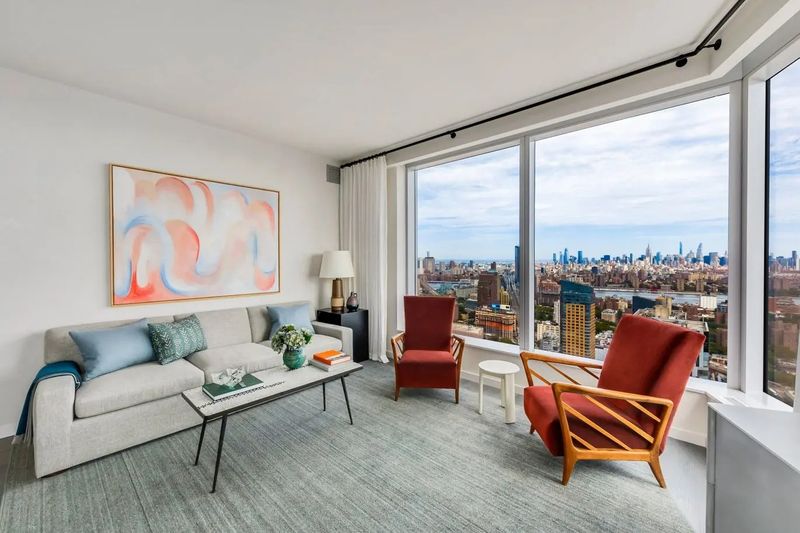
Brooklyn Point brought Manhattan-standard tower amenity to Downtown Brooklyn. The residential tower sits within City Point, a large mixed-use development combining retail and food hall uses at its base, at a location served by one of the densest subway interchanges outside Manhattan.
For a buyer weighing boroughs, it poses the question directly: what does the same monthly budget buy on this side of the river? Let's work through it with the numbers.
1. What the Building Is

A glass residential tower above a mixed-use base. The City Point context is the defining feature: retail and food hall uses at ground and podium level, which produces a different street condition from a residential building on a quiet block.
Whether that is an advantage depends on how you live. Convenience at the door is genuinely valuable; so is a quiet entrance. Both are legitimate preferences and only one of them describes this building.
| Attribute | Detail |
|---|---|
| Address | 138 Willoughby Street, Downtown Brooklyn |
| Context | Residential tower within the City Point development |
| Base uses | Retail and food hall |
| Ownership | Condominium |
| Board approval | Right of first refusal only |
| Transport | Dense Downtown Brooklyn subway interchange nearby |
Building facts. Unit-level figures — size, charges, tax, abatement status — must be obtained for the specific residence.
The location is on Google Maps here.
2. The Abatement Question Comes First
This is the item that most affects what an apartment here actually costs to own over time. Buildings of this vintage in New York frequently carry a property tax abatement that steps down on a published schedule, and on a condominium the owner pays that tax directly.
Establish four things in writing before making an offer: which programme applies, how many years remain, the step-down schedule, and the estimated unabated tax on the specific unit. Then model the total monthly cost at full expiry rather than at today's figure.
If the purchase only works at the abated tax, it does not work. Our tax abatements guide explains the mechanics and how remaining term should affect the price you pay.
3. What the Borough Saves

The carrying cost difference is real and compounds. Brooklyn condominium operating expense runs a median $10.92 per square foot a year against Manhattan's $15.52 — roughly $910 versus $1,293 monthly on 1,000 square feet, before property tax.
Over a decade that gap is substantial, and the same budget generally buys more space here. What you give up is some international resale recognition: a global buyer who has never visited knows Manhattan addresses in a way they may not know Brooklyn ones.
Our Manhattan versus Brooklyn comparison works through the trade in full, including the borough-level data behind those figures.
4. Buying Here as an Overseas Purchaser

Procedurally identical to Manhattan: a condominium, no board approval vote, non-resident and entity ownership accepted. Brooklyn's newer stock skews far more heavily condominium than Manhattan's largely cooperative inventory, so a much greater share of what appears in a search here is genuinely available to a foreign buyer.
Mansion tax applies from $1 million on the whole price regardless of borough. Where units remain with the sponsor, the New York City and State transfer taxes are customarily shifted onto the purchaser — roughly a further 1.8 to 2.0%.
Settle ownership structure before contract; the $60,000 US estate tax exemption for non-residents applies here as everywhere. See our new development guide and estate tax guide.
Living above a retail podium
A mixed-use base changes the daily experience in ways a floor plan does not show. Deliveries, service access, operating hours and foot traffic all belong to businesses rather than to residents, and the separation between the two is a design question with a specific answer in each building.
Ask where residents enter, how the residential lobby relates to the retail entrances, and how deliveries for the commercial tenants are handled. Then ask for a live walkthrough that includes the street approach at a busy hour rather than an empty one.
Sponsor inventory and board control
In any recent development, establish how many units the sponsor still holds. While a significant block remains unsold the sponsor controls the board, sets budgets and reserve contributions, and can dispose of units in bulk at a discount that resets the comparables under your own resale.
Ask when board control transfers and what proportion of units has closed. Those two answers describe who is setting your monthly costs for the next few years better than any amenity list.
Final Thoughts: Model the Tax to Expiry
Brooklyn Point suits a buyer who wants tower amenity and transport convenience without Manhattan's carrying costs, and who will do the one piece of arithmetic that matters here: the total monthly cost at full unabated tax, not at today's bill. Get that number and the decision becomes straightforward in either direction.
We cover Brooklyn and Manhattan on Satoshi Onodera's YouTube channel and on Instagram. If a line here is in view, talk to our team and we will obtain the abatement schedule and the financials first. Real estate brokerage services are provided through licensed professionals.
The honest summary for an overseas buyer is that Downtown Brooklyn now offers genuine tower living at a materially lower running cost than Manhattan, with a resale audience that is deep domestically and thinner internationally. For an owner who will use the apartment and hold it for years, that trade usually favours the borough. For one who may need to sell quickly to a buyer abroad, it usually does not.
A final point on where this building sits in the borough. Downtown Brooklyn now has several towers competing for the same buyer, and they differ mainly in base condition, amenity depth and abatement status rather than in location, since they are within a few blocks of each other.
That makes the comparison unusually tractable. Put the candidates side by side on total monthly carrying cost per square foot at full unabated tax, and the ranking usually resolves itself without any judgement about which lobby is nicer.
For an overseas buyer specifically, the borough's condominium-heavy inventory is worth weighing against Manhattan's largely cooperative stock. A Brooklyn search of a hundred listings contains far more apartments a non-resident purchaser can realistically pursue, and the search time that saves is real rather than theoretical.
Do that arithmetic before anything else, and the rest of the decision tends to follow on its own without much further argument or debate.
Reinvent NY provides business consulting, operational support, and coordination services. Legal advice and immigration filings are handled by independent licensed attorneys. Real estate services are provided through licensed professionals and applicable brokerage relationships. This article is for informational purposes only and does not constitute legal or investment advice.
More buildings worth knowing: 432 Park Avenue, 53 West 53rd, Aman New York Residences. The full set is indexed under New York building profiles.

Satoshi Onodera
Founder & CEO, Reinvent NY Inc.
Founded Reinvent NY in 2024. Providing relocation support from all over the world to America.
Ready to Get Started?
Our team in New York is ready to help with your visa, real estate, or relocation needs.
Schedule a ConsultationFrequently Asked Questions
Where is Brooklyn Point?
138 Willoughby Street, part of the City Point development in Downtown Brooklyn. The location is on [Google Maps](https://maps.google.com/?q=138+Willoughby+Street+Brooklyn).
What is City Point?
A large mixed-use development in Downtown Brooklyn combining retail, food hall and residential uses. Brooklyn Point is the residential tower within it.
Is there a tax abatement?
Buildings of this type frequently carry a property tax abatement that steps down over time. Establish which programme applies, the remaining term and the estimated unabated tax before making an offer.
How do costs compare with Manhattan?
Brooklyn condominium operating expense runs a median $10.92 per square foot a year against Manhattan's $15.52 — roughly $910 versus $1,293 monthly on 1,000 square feet, before property tax.
Can an overseas buyer purchase here?
Yes. It is a condominium, so there is no board approval vote, and non-resident and entity ownership are accepted.
What is the transport position?
Downtown Brooklyn sits at one of the densest subway interchanges outside Manhattan. Verify the specific station and the actual walk for the unit rather than relying on a borough-level claim.
What should I confirm first?
The abatement schedule and unabated tax, the reserve balance, assessment history, how many units the sponsor still holds, and the actual charges for the specific unit.
Real Estate Guides & Data
Related Articles
Fort Greene Brooklyn Real Estate Guide 2026
Our 2026 guide to Fort Greene, Brooklyn: townhouses, condos, prices, rents, schools, and transit access for international buyers and renters alike.
Pied-a-Terre NYC: A 2026 Guide for Part-Time Owners
What a pied-a-terre in NYC really costs in 2026: co-op restrictions, second-home financing, lost tax benefits, and the 30-day rule on renting it out.
Prospect Heights Brooklyn Real Estate Guide 2026
An expert 2026 guide to Prospect Heights, Brooklyn: boundaries, housing stock, prices, rents, transit, and schools for international buyers and renters.
421-a Tax Abatement: A 2026 Guide for NYC Condo Buyers
How the 421-a tax abatement phases out, what it does to a NYC condo's monthly carry and resale price, and exactly what to verify before you sign.