DSCR Loan for Foreign Nationals: 2026 Terms Explained
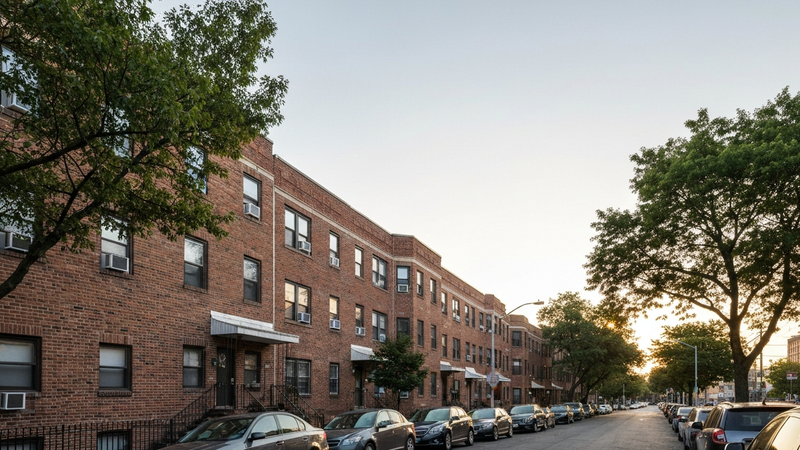
A rental building in Queens does not know where its owner files a tax return. That is the entire premise of the DSCR loan — a mortgage underwritten on the income the property produces rather than the paperwork the borrower can produce.
For foreign nationals and self-employed investors, that distinction is often the difference between closing and walking away. There are no W-2s to collect, no two-year US employment history, and in most programs no US tax returns at all.
In this article, we'll break down how the ratio is calculated, what terms foreign buyers are seeing in 2026, how DSCR financing compares with conventional and full-documentation alternatives, and which contract terms quietly cost borrowers money at year three.
How a DSCR Loan Is Underwritten
Approval turns on a single number. DSCR is the property's gross monthly rent divided by its monthly PITIA — principal, interest, taxes, insurance, and association dues — and most lenders want that figure at 1.00 or higher.
A ratio of 1.00 means the rent exactly covers the payment. Programs that accept 0.75 to 0.99 do exist, but the shortfall is priced in through a larger down payment, a higher rate, or both.
| Line item | Monthly amount |
|---|---|
| Gross market rent | $6,800 |
| Principal and interest ($750,000 at 7.25%, 30-year fixed) | $5,117 |
| Property taxes | $780 |
| Insurance | $190 |
| HOA or common charges | $450 |
| Total PITIA | $6,537 |
| DSCR (rent divided by PITIA) | 1.04 |
Illustrative example on a $1,000,000 purchase with 25% down. Rate and expense assumptions vary by lender, property, and closing date.
The rent figure is not taken on trust. The appraisal includes a Form 1007 market rent schedule, and lenders generally underwrite the lower of the signed lease rent or the appraiser's market rent.
That single convention ends more deals than credit does. An optimistic pro forma rarely survives the appraiser, so build the rent assumption before the offer — our rental yield guide walks through the arithmetic.
What the ratio leaves out
PITIA is the entire denominator. Vacancy, management fees, repairs, and capital reserves are not deducted, so a property that clears 1.05 on the lender's worksheet can still run negative once a 5% vacancy allowance and an 8% management fee are applied to it.
Underwrite the deal twice, then. Once at the lender's standard to confirm it funds, and once at your own to confirm it earns.
A worked example that does not clear
Take an $800,000 Queens condominium renting at $4,500 a month. With 25% down, the $600,000 loan carries about $4,094 in principal and interest at 7.25%, plus roughly $520 in taxes, $120 in insurance, and $700 in common charges — a PITIA near $5,434.
That is a DSCR of 0.83, and it does not fund on a standard program. Raising the deposit to 45% cuts the loan to $440,000, the PITIA to roughly $4,342, and the ratio to 1.04.
The lesson is not that the apartment is a bad asset. It is that high common charges and high property taxes make dense urban condominiums hard to finance on rent alone, which is why DSCR volume concentrates in one-to-four unit houses and small multifamily rather than in tower condominiums.
2026 Terms for Foreign National Borrowers

Expect to put down more than a US resident would. 25% to 30% down is the working range for foreign national DSCR programs in 2026, against roughly 20% to 25% for a US-based investor with an identical property and an identical rent roll.
Pricing sits approximately one to two percentage points above a comparable conventional investment-property loan, plus one to two origination points. Rates move weekly, so treat any quoted figure as a snapshot rather than a term sheet.
What replaces the tax return
Lenders substitute asset and identity documentation for income documentation. A typical foreign national file includes a passport, a US bank account, an ITIN or foreign tax identification number, two or three reference letters from international banks, and three to six months of PITIA held in reserves.
Credit is handled the same way. Where no US credit score exists, most programs accept an international credit report or bank references in place of the 680-plus score they would otherwise want. Our foreign national mortgage guide sets out the full document list.
Loan sizes and structures
Most programs lend from roughly $100,000 to $3,500,000 against one-to-four unit residential property, condominiums, and small multifamily buildings. Thirty-year fixed is the standard structure, with 5/1 and 7/1 adjustable options and interest-only periods available at a modest premium.
Loan-to-value caps tighten as the ratio falls. A 1.25 DSCR may support 75% financing where a 0.90 file is held to 65%, which means the deposit and the rent assumption move together rather than as separate variables.
DSCR vs. Conventional vs. Full-Doc Foreign National Loans

The three routes differ less in rate than in what they demand of the borrower. Conventional financing is the cheapest and the most restrictive. Full-documentation foreign national loans sit in between. DSCR trades roughly a point of rate for the removal of personal income underwriting altogether.
Speed follows from the same difference. A DSCR file needs an appraisal, a lease, an insurance binder, and proof of reserves, and commonly closes in 21 to 30 days — against 45 days or more for a full-documentation file waiting on translations and bank verifications in another time zone.
| Feature | DSCR loan | Conventional investment loan | Foreign national full-doc |
|---|---|---|---|
| What is underwritten | Property rent against PITIA | Personal income and debt-to-income ratio | Foreign income, translated |
| Income documents | None required | Two years of returns plus W-2 or 1099 | Employer and bank letters, translations, often a CPA letter |
| Typical down payment | 20-25% US, 25-30% foreign national | 15-25% | 30-40% |
| Title held in an LLC | Permitted | Not permitted | Lender-dependent |
| Prepayment penalty | Common, three to five years | None | Varies by lender |
| Rate versus conventional | Approx. +1 to +2 points | Baseline | Approx. +1 to +1.5 points |
Ranges reflect 2026 norms across non-agency lenders rather than quotes; individual programs vary widely.
However, some argue that DSCR loans are an expensive convenience — that a borrower with clean, translatable income documents should take the cheaper full-documentation route and keep the rate premium in their pocket.
That holds for one purchase. It stops holding at the third or fourth, where conventional lenders count every mortgage against a personal debt-to-income ratio and each foreign income package needs fresh translation. DSCR underwriting scales because every property is judged on its own rent.
LLC Vesting, Prepayment Penalties, and the Fine Print

DSCR loans permit title to be held in an LLC, which agency financing does not. Fannie Mae and Freddie Mac require individual vesting, so investors who want liability separation are pushed toward the non-agency market by structure alone.
That choice reaches past liability. Entity ownership shapes how rental income is reported and how a future sale is taxed — see our notes on US holding structures and on rental income tax for non-residents, alongside IRS Topic 414.
The prepayment penalty is the real cost
Because DSCR loans are business-purpose rather than consumer loans, they carry prepayment penalties that a primary-residence mortgage cannot. The common structures are a five-year step-down of 5/4/3/2/1 percent of the balance, a three-year 3/2/1, or a flat 5% for three years.
Buying the penalty down to zero typically costs somewhere between a quarter point and a full point in rate. If the plan is to refinance or sell inside three years, price the penalty before the rate — it is usually the larger number.
The step-down is charged against the balance outstanding in the year of payoff. On a $600,000 loan under a 3/2/1 structure, retiring the debt in year one costs $18,000, in year two $12,000, and in year three $6,000, with nothing owed from year four onward.
Rate buydowns run in the opposite direction. One discount point — 1% of the loan, or $6,000 on that same balance — typically buys about a quarter point of rate, worth roughly $102 a month here, so the buydown recovers its cost in about five years.
One further clause deserves attention: cash-out refinance seasoning. Many lenders require six to twelve months of ownership before they will lend against a new appraised value, which matters for anyone buying with cash and planning to recapitalize once a renovation is complete.
Final Thoughts
DSCR lending exists because the agency box was built around US wage earners, and a large share of the capital entering the American rental market does not look like that. The loan is not a workaround; it asks a different underwriting question.
The trade is explicit. Roughly a point of rate and a larger deposit buy speed, entity ownership, and a file that does not depend on foreign income documents surviving translation and a lender's interpretation of them.
Run the ratio before the offer, not after. A property that appraises at a 1.05 DSCR is financeable; one that pencils at 0.90 needs a larger deposit or a lower price, and that is a conversation to have with the seller rather than the lender. For current state-level price and rent data, see our New York market page.
Reinvent NY provides business consulting, operational support, and coordination services. Legal advice and immigration filings are handled by independent licensed attorneys. Real estate services are provided through licensed professionals and applicable brokerage relationships. This article is for informational purposes only and does not constitute legal or investment advice.

Satoshi Onodera
Founder & CEO, Reinvent NY Inc.
Founded Reinvent NY in 2024. Providing relocation support from all over the world to America.
Ready to Get Started?
Our team in New York is ready to help with your visa, real estate, or relocation needs.
Schedule a ConsultationFrequently Asked Questions
What DSCR do lenders require?
Most programs set the floor at 1.00, meaning gross rent covers PITIA exactly, and price their best terms at 1.20 to 1.25. Ratios between 0.75 and 0.99 are available from some non-agency lenders, but they come with a larger down payment, a higher rate, or both.
Can a foreign national get a DSCR loan without a US credit score?
Yes. Where no US credit file exists, lenders typically accept an international credit report or two to three reference letters from banks in the borrower's home country. A US bank account and an ITIN or foreign tax identification number are usually still required.
How much rent counts toward the ratio?
Lenders generally use the lower of the signed lease rent or the market rent shown on the appraiser's Form 1007 rent schedule. Projected rents from a seller's pro forma carry no weight unless the appraiser independently supports them.
Can the property be held in an LLC?
Yes, and this is one of the main reasons investors choose DSCR financing. Conventional agency loans from Fannie Mae and Freddie Mac require individual vesting, while DSCR lenders routinely close in the name of a US LLC with a personal guarantee from the members.
How much higher are DSCR rates than conventional?
Roughly one to two percentage points above a comparable conventional investment-property loan in 2026, plus one to two origination points. Foreign national files usually sit at the wider end of that range. Rates move weekly, so confirm pricing at the time of application.
Do DSCR loans have prepayment penalties?
Most do, because they are business-purpose loans. Typical structures are a five-year step-down of 5/4/3/2/1 percent of the outstanding balance, a three-year 3/2/1, or a flat 5% for three years. Removing the penalty generally costs a quarter point to a full point in rate.
Are DSCR loans available for short-term rentals?
Some lenders will underwrite short-term rental income, usually from twelve months of platform history or third-party market data rather than a lease. Expect a lower maximum loan-to-value ratio and larger reserve requirements than on a long-term lease.
Is US rental income still taxable if the loan requires no tax returns?
Yes. The lender's documentation requirements have no bearing on tax obligations. Non-resident owners of US rental property generally file an annual US return and may elect to be taxed on net rental income rather than on gross receipts, so plan the filing position before closing.
Real Estate Guides & Data
More guides
- FIRPTA and Seller Costs: What a Foreign Owner Actually Nets
- NYC Sponsor Units: Buying Without Board Approval
- The 183-Day Rules: Tax Residency by the Calendar
- US Metro Comparison: Price, Rent, Yield and Growth
- Vacancy and Turnover: The Cost Between Tenants
- Wire Fraud at Closing: The One Loss Nobody Insures
Related Articles
NYC Mansion Tax 2026: All Eight Brackets Explained
The NYC mansion tax runs from 1.00% to 3.90% on residential purchases of $1,000,000 or more. Full 2026 bracket schedule, who pays, and how to plan for it.
Two Bridges Manhattan Real Estate Guide 2026
A concrete 2026 guide to Two Bridges, Manhattan: buildings, prices, rents, transit and daily life for overseas buyers and renters.
Chinatown Manhattan Real Estate Guide 2026
A local advisor's guide to buying or renting in Chinatown, Manhattan — boundaries, buildings, prices, transit, and who the neighborhood truly suits.
Little Italy Manhattan Real Estate Guide 2026
What Little Italy in Manhattan costs in 2026: the buildings and their ages, sale and rent ranges, what the district rules restrict, and how to read it.