Buying New Construction in Hudson Yards: Terms to Read
Hudson Yards is the rarest thing in Manhattan: a neighbourhood that arrived all at once. Built over the West Side rail yards, the district combined residential towers, offices, retail and public space in a single master plan rather than accumulating over a century as the rest of the city did.
That makes it a genuinely different purchase from an apartment in an established neighbourhood. Let's look at what it offers and what a buyer should establish.
1. What Buying Into a Planned District Means

Everything is new at the same time, which has two consequences pointing in opposite directions. The infrastructure is contemporary — systems, energy performance, accessibility and layout all reflect current standards rather than retrofits onto older structures.
And the district has no long operating history. In an established neighbourhood you can see how a block has behaved over decades. Here the question is how a place performs as it matures, and the answer is still being written.
| Attribute | Detail |
|---|---|
| Location | Manhattan's far West Side, over the rail yards |
| Character | Master-planned mixed-use district |
| Uses | Residential, office, retail and public space |
| Building age | Recent construction throughout |
| Ownership | Condominium in the residential buildings |
| Transport | Subway extension terminating in the district |
District facts. Building and unit-level figures — ownership form, charges, tax, abatement status — must be confirmed for the specific residence.
The location is on Google Maps here.
2. What New Construction Delivers
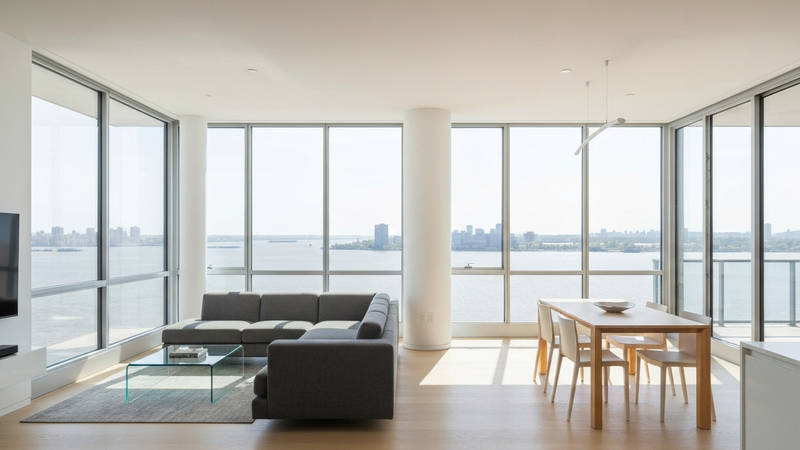
Regular floor plates, current building systems and layouts designed for how apartments are actually used now. That is a real advantage over conversions and prewar stock, where a buyer inherits decisions made for a different era and frequently pays to work around them.
It also means amenity provision funded permanently through common charges. Pools, lounges, terraces and staffed facilities consume heat, insurance, cleaning and payroll whether or not any individual owner uses them, and that cost does not fall when usage does.
Compare the charge per square foot against operating buildings of similar scale rather than accepting the projection. Our guide to evaluating large towers covers the full checklist.
3. Abatements and Sponsor Position

Two questions matter more here than in an older building. First, whether a property tax abatement applies and when it steps down — on a condominium the owner pays that tax directly, so an expiry lands on your budget rather than the building's.
Second, how many units the sponsor still holds. While a significant block remains unsold the sponsor controls the board, sets budgets and reserve contributions, and can dispose of units in bulk at a discount that resets the comparables under your own resale.
Both are answerable in writing before an offer. Our tax abatements guide and new development guide set out what to ask for.
4. Buying Here as an Overseas Purchaser

Where the ownership is condominium, procedurally straightforward: no board approval vote, non-resident and entity ownership accepted, subletting subject to building rules rather than a board's discretion. Newly built districts skew heavily condominium, which is why they appear disproportionately on international shortlists.
Mansion tax applies from $1 million on the whole price. Where units remain with the sponsor, the New York City and State transfer taxes are customarily shifted onto the purchaser — roughly a further 1.8 to 2.0% of the price.
Settle ownership structure before contract; US estate tax reaches non-resident owners above a $60,000 exemption on US-situs assets. See our estate tax guide.
What a district still maturing looks like
Master-planned neighbourhoods take time to acquire the texture that older ones already have — the independent businesses, the routines, the slightly unplanned character that accumulates rather than being designed. Some of that is arriving; some of it takes decades.
For a buyer the practical question is whether you want the finished article now or are comfortable holding through the period in which a place becomes itself. Neither answer is wrong, and only one of them describes this district today.
The West Side position
The location is genuinely convenient for the Midtown West office district and for transport, and the river outlook from higher floors is one that established neighbourhoods further east cannot offer at any price.
Verify the specific walk and the subway line for the building you are considering rather than relying on district-level claims. A five-minute difference in the approach matters far more day to day than a marketing map suggests.
Final Thoughts: A District Still Proving Itself

Hudson Yards offers contemporary buildings, planned public space and transport built for the district rather than adapted to it. What it cannot offer yet is the evidence an established neighbourhood provides — decades of behaviour through cycles. A buyer who values the first should look here; one who wants the second should look at a neighbourhood that has already had time to become one.
We cover the West Side on Satoshi Onodera's YouTube channel and on Instagram. If a building here is in view, talk to our team and we will obtain the abatement schedule, the sponsor position and the financials first. Real estate brokerage services are provided through licensed professionals.
For an overseas buyer there is one further advantage worth naming. A district built recently and almost entirely as condominium means a much higher proportion of the inventory is genuinely available to a non-resident purchaser than in Manhattan's older, largely cooperative neighbourhoods — which shortens a search considerably.
A last comparison worth making. The established Manhattan neighbourhoods offer proven character and older buildings; this district offers current construction and planned infrastructure without the accumulated texture. Buyers frequently arrive assuming they want one and discover on the ground that they want the other.
That is a good reason to see both before committing, even remotely. A live walkthrough of a Hudson Yards tower and one of a prewar building on the Upper West Side, viewed in the same week, settles the question faster than any amount of comparison on paper.
For a first-time buyer in New York the district has one further practical advantage: everything is documented, current and comparable. There is no century of deferred maintenance to interpret, no prewar quirk to price, and the comparables within each building are numerous. That makes it an easier market to underwrite confidently from abroad than almost anywhere else in Manhattan.
One last practical note on timing. Because so much of the district was completed within a short span, the buildings share a maintenance cycle, and major capital items will fall due across them at broadly similar times. Ask the reserve study directly what is scheduled in the next decade and how it is funded, because a well-reserved building and an underfunded one look identical from the lobby.
Reinvent NY provides business consulting, operational support, and coordination services. Legal advice and immigration filings are handled by independent licensed attorneys. Real estate services are provided through licensed professionals and applicable brokerage relationships. This article is for informational purposes only and does not constitute legal or investment advice.

Satoshi Onodera
Founder & CEO, Reinvent NY Inc.
Founded Reinvent NY in 2024. Providing relocation support from all over the world to America.
Ready to Get Started?
Our team in New York is ready to help with your visa, real estate, or relocation needs.
Schedule a ConsultationFrequently Asked Questions
Where is Hudson Yards?
On Manhattan's far West Side, built over the rail yards between roughly 30th and 34th Streets west of Tenth Avenue. The location is on [Google Maps](https://maps.google.com/?q=Hudson+Yards+New+York).
What is different about buying there?
The district was master-planned and built largely at once, so the residential buildings, retail, offices and public space arrived together rather than accumulating over decades.
Are the residences condominiums?
The residential buildings include condominium ownership. Confirm the ownership form and the documents for the specific building and unit you are considering.
Are there tax abatements?
Some buildings in newer districts carry property tax abatements that step down over time. Establish which programme applies to the specific building, the remaining term and the unabated figure.
Can an overseas buyer purchase here?
Where the ownership is condominium, yes — no board approval vote, and non-resident and entity ownership are generally accepted.
What is the transport position?
The district is served by a subway extension terminating there, plus proximity to Penn Station. Verify the specific walk and line for the building rather than relying on a district-level claim.
What should I confirm first?
The abatement status and unabated tax, the reserve balance, assessment history, how many units the sponsor still holds, and the actual charges for the specific unit.
Real Estate Guides & Data
More guides
- FIRPTA and Seller Costs: What a Foreign Owner Actually Nets
- NYC Sponsor Units: Buying Without Board Approval
- The 183-Day Rules: Tax Residency by the Calendar
- US Metro Comparison: Price, Rent, Yield and Growth
- Vacancy and Turnover: The Cost Between Tenants
- Wire Fraud at Closing: The One Loss Nobody Insures
Related Articles
NYC Co-op Board Approval for Overseas Buyers
Why New York co-op boards reject overseas buyers, what the package must show without US credit or W-2 income, and when a condo is the faster route instead.
Financing a Branded Residence as a Foreign National
How overseas buyers finance branded residences in New York: 30-40% down on pre-construction, deposit schedules.
Bedford-Stuyvesant Brooklyn Real Estate Guide 2026
An in-depth 2026 guide to Bedford-Stuyvesant real estate: boundaries, housing stock, prices, rents, transit, and buyer fit for international clients.
Bushwick Brooklyn Real Estate Guide 2026
An authoritative 2026 guide to Bushwick, Brooklyn for overseas buyers and renters: boundaries, buildings, prices, transit, and who the neighborhood suits.