How Interest Rates Move US Property Prices
Higher rates lower property prices. It is the most repeated claim in real estate, and after 2022 it half failed: US mortgage rates more than doubled, and house prices did not fall. Over the same period, office building values dropped sharply.
The same rate move produced opposite outcomes because it travels through two different channels — one that changes what buyers can borrow, and one that changes what investors demand in return. Which channel reaches your asset depends on how that asset is financed.
In this article, we separate the two mechanisms, quantify each, and explain why the supply side rewrote the expected result in housing but not in commercial property.
1. The Borrowing Channel: What a Buyer Can Afford
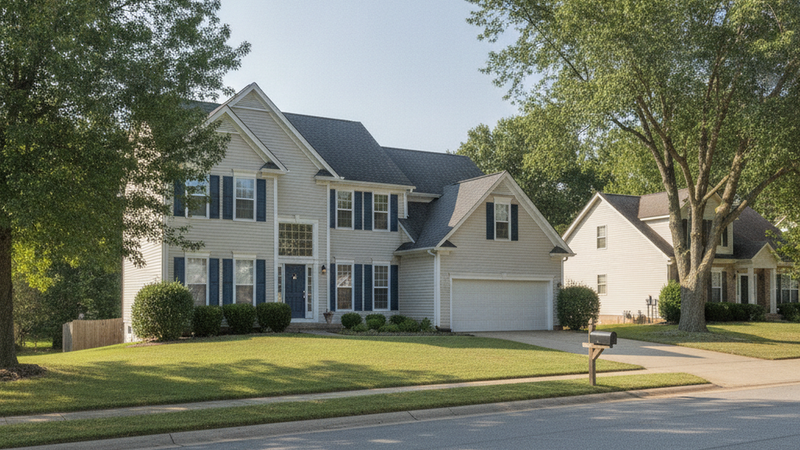
Most residential buyers set a budget from the monthly payment rather than the purchase price. Hold that payment constant, change the rate, and the principal it supports moves a long way.
At $3,000 a month on a 30-year fixed loan, a 3% rate supports roughly $710,000 of principal. At 6%, the same payment supports about $500,000. The buyer's monthly outlay has not risen by a dollar, and their price range has fallen by roughly 30%.
This calculation runs for every financed buyer simultaneously, which is why rising rates are described as draining demand from the housing market. How the loan itself is structured for overseas buyers is covered in our guide to how US mortgages work and in our article on the foreign national mortgage.
Two qualifications matter. The effect is largest where buyers are most leveraged, so entry-level markets move more than the top of the market, where cash and low loan-to-value purchases are common. Manhattan's prime tier is comparatively insulated for exactly that reason.
The effect is also about the payment rather than the rate itself. Property taxes and building charges compete for the same monthly budget, which is why a high-tax or high-common-charge building loses more buying power per dollar of price than the headline rate alone would suggest.
2. The Discount Rate Channel: What Investors Demand

Income-producing property is valued by dividing net operating income by a capitalisation rate. That cap rate is the yield an investor requires — broadly the risk-free rate plus a premium for the specific asset.
When government bond yields rise, required yields on property rise with them. Hold income constant, raise the required yield, and the value falls — with no change in rent, occupancy or condition.
| Mortgage rate | Principal at $3,000/month | Cap rate | Value at $100,000 NOI |
|---|---|---|---|
| 3% | About $710,000 | 4.0% | $2,500,000 |
| 4% | About $630,000 | 4.5% | About $2,220,000 |
| 5% | About $560,000 | 5.0% | $2,000,000 |
| 6% | About $500,000 | 5.5% | About $1,820,000 |
| 7% | About $450,000 | 6.0% | About $1,670,000 |
Illustrative only: a 30-year fixed amortising loan, and income capitalised at the stated rate. Actual pricing reflects location, age, lease terms and much else.
The comparison in the table makes the asymmetry visible. A cap rate moving from 4.0% to 5.5% takes 27% off the value of a building whose rent never changed — income property reprices on the yield, not on the rent roll. Our rental yield guide works through the same arithmetic on a specific apartment.
The same sensitivity works in the owner's favour when rates fall, which is why income property is often described as a leveraged bet on the yield curve. It also explains why buyers of income property watch bond markets more closely than housing statistics.
For a New York condominium bought partly for rental income, both channels apply at once: the resale price responds to what financed buyers can pay, while the investment case responds to required yields. Our guide to reading financial statements covers how building-level costs feed into the income half of that equation.
3. Why US House Prices Refused to Fall
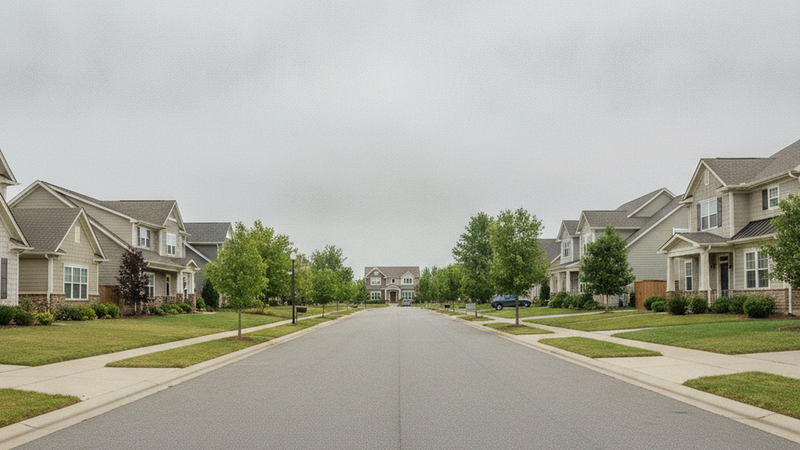
In theory, doubling mortgage rates should have dragged house prices down. Nationally they did not fall, and in many markets they kept rising. The explanation sits on the supply side, not the demand side.
The 30-year fixed mortgage dominates US housing. Owners who refinanced during the low-rate period would have to replace that loan at current rates in order to move, so they stopped selling. Listings disappeared faster than buyers did.
Commercial property had no such lock. Commercial loans run for shorter terms and must be refinanced every few years, so when maturities arrived at higher rates, holding became untenable and owners sold into a weaker market. The lesson generalises: the effect of rates on a property depends on the debt that supports it. Our guide to owning through market cycles traces how this has played out before.
For an overseas buyer this asymmetry has a practical consequence. Thin listings mean less negotiating room on price in housing, while commercial and some new-development inventory has been more willing to move on terms. Where flexibility exists, it currently sits with the assets that carry short-dated debt.
4. The Case for Waiting, and Why It Usually Loses

However, some argue the obvious response is to wait: buy after rates fall and carry the same property at a lower payment. Where a plan depends on high leverage, this has real force — the rate drives the monthly result directly, and there is no virtue in forcing a purchase through an expensive financing window.
The rebuttal is that lower rates rarely arrive alone. The borrowing calculation above applies to every buyer at once, so when rates fall, every budget expands simultaneously and competes for the same limited inventory. Cheaper money and cheaper prices seldom appear together.
There is also an asymmetry worth naming. A rate can be refinanced later; a purchase price cannot. Buy well at a high rate and refinancing repairs the payment. Overpay at a low rate and nothing repairs the price. The workable test is whether the property performs at today's rate, which our deal analysis approach sets out and our refinancing guide extends to the exit.
A cash buyer faces a version of the same question. Without a loan there is no payment to repair later, so the entry price carries the entire decision — which argues for patience on price and indifference to the rate, the reverse of the financed buyer's position.
5. Final Thoughts

Rates reach property through two channels. In housing they compress what buyers can borrow and drain demand. In income property they raise required yields and cut valuations directly, regardless of rent.
What 2022 onward demonstrated is that neither channel decides the outcome alone. Housing held because supply contracted faster than demand; offices fell because refinancing forced sales. The variable that separated them was the debt structure, not the rate.
When you read the next rate headline, look past the direction and ask how the asset in question is financed and when that financing matures. If you would like the numbers run on a specific property at today's rates, tell us the holding period and the source of funds, and our team will work through it with you.
Reinvent NY provides business consulting, operational support, and coordination services. Legal advice and immigration filings are handled by independent licensed attorneys. Real estate services are provided through licensed professionals and applicable brokerage relationships. This article is for informational purposes only and does not constitute legal or investment advice.
More on investing: How to Buy Investment Property 2026, Real Estate Crowdfunding USA, REIT Investment for Foreigners 2026.

Satoshi Onodera
Founder & CEO, Reinvent NY Inc.
Founded Reinvent NY in 2019. Providing relocation support from all over the world to America.
Ready to Get Started?
Our team in New York is ready to help with your visa, real estate, or relocation needs.
Schedule a ConsultationFrequently Asked Questions
How much does a 1% rate rise reduce what I can borrow?
On a 30-year fixed loan at a constant monthly payment, roughly 8-10% of principal per percentage point in the current range. At $3,000 a month, moving from 3% to 6% cuts the supported principal from about $710,000 to about $500,000.
Why did US house prices not fall when rates doubled?
Supply contracted faster than demand. Owners holding low-rate 30-year fixed mortgages would have had to refinance at current rates to move, so they stayed put and listings dried up. Fewer buyers chased even fewer homes.
Why did office values fall when houses did not?
Commercial loans are short-dated and must be refinanced every few years. When maturities arrived at higher rates, owners could not simply hold, and forced sales pushed prices down. Residential owners with fixed 30-year debt faced no equivalent deadline.
What is a cap rate and why does it matter more than rent?
The capitalisation rate is the yield an investor requires, and value equals net operating income divided by that rate. Because it is a divisor, small moves swing value sharply: at $100,000 of income, a shift from 4.0% to 5.5% removes 27% of value with no change in rent.
Should I wait for rates to fall before buying?
Rarely on rate grounds alone. Lower rates expand every buyer's budget at the same time and typically push prices up against limited inventory. A rate can be refinanced later; a purchase price cannot. Test whether the property works at today's rate.
Do rate moves affect condominiums and co-ops differently?
Both are residential and respond mainly through the borrowing channel, but co-ops often carry building-level underlying mortgages that reprice on their own schedule, which can feed into monthly charges. Review the building's financials before assuming rate exposure stops at your own loan.
Does any of this change for a cash buyer?
A cash purchase removes personal exposure to the borrowing channel, but not to the market. Prices are set at the margin by financed buyers, and income property is still valued off cap rates that move with bond yields. Rates continue to shape your entry price and your eventual exit.
Real Estate Guides & Data
More guides
- Why New York: The Long Case for the Deep Market
- Building Amenities: What the Pool Actually Costs You
- Bidding Wars in NYC: Winning Without Overpaying
- Building Staff and Holiday Tipping: The Unwritten Rules
- Buying Your Office: Commercial Condos for Founders
- The US Closing Timeline: Attorney States vs Escrow States
Related Articles
Pelham Bay Bronx Real Estate Guide 2026
An overseas buyer's guide to Pelham Bay, Bronx: housing stock, prices, rents, transit, and schools, from Reinvent NY's local advisory team.
Skyline Tower: The Tallest Building in Queens
Skyline Tower is the tallest building in Queens, minutes from Midtown by subway. See the sales the city has recorded there since 2023 and the median price.
IRS Audits and Foreign Owners of US Property
Audit rates sit below 1%, but rental property, foreign accounts and cross-border income raise the score. The five issues examined, and the records to keep.
Mott Haven Real Estate Guide 2026
A 2026 guide to Mott Haven, Bronx real estate: housing stock, prices, rents, transit, and schools for international buyers and renters.