Buying NYC Property From Abroad: The Practical Logistics
The legal side of buying in New York from another country is settled and unremarkable: no residency requirement, recorded title, insurable ownership. What actually delays overseas purchases is logistics — funds that take longer to move than anyone planned, documents executed in the wrong form, and a compliance review nobody scheduled.
None of it is difficult once it is sequenced. Let's work through the practical mechanics in the order they arise.
1. Money: Moving It and Proving It

Every US closing verifies the source of funds under anti-money-laundering obligations. This is routine rather than adversarial, and it means documentation: evidence that the money came from a business sale, an inheritance, accumulated employment income, or the disposal of another property.
Two practical constraints catch buyers out. International wires take business days rather than hours, and many banks apply daily transfer limits that require advance arrangement for a seven-figure payment. Both are solvable a week ahead and unsolvable on closing morning.
| Stage | Lead time to allow | Common failure |
|---|---|---|
| Source of funds documentation | At search stage | Assembled only when requested |
| Bank transfer limit increase | 1-2 weeks | Discovered at closing |
| International wire execution | 2-5 business days | Assumed to be same-day |
| Power of attorney execution abroad | 2-4 weeks | Wrong form or missing apostille |
| Certified translation of financials | 2-3 weeks | Started after lender request |
Typical lead times for overseas buyers. Requirements vary by country and institution; confirm each with your own bank and attorney.
One rule overrides everything else here: verify wire instructions by voice before sending, on a number you already had rather than one from an email. Our buyer protections article explains why this is the one loss that insurance does not cover.
2. Signing Without Being There
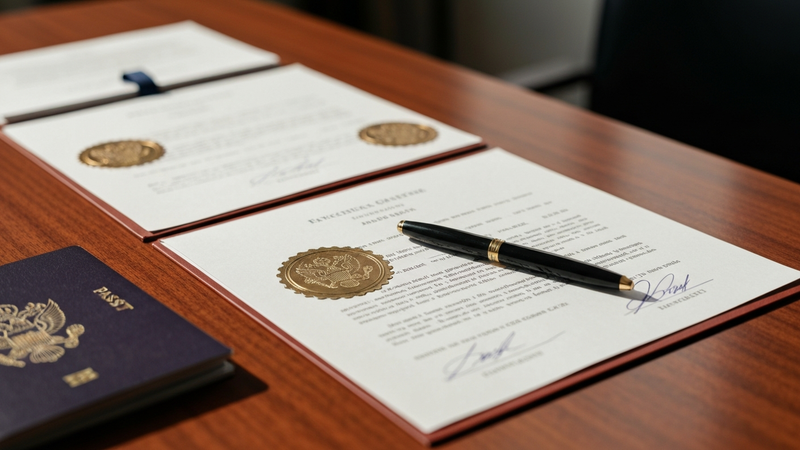
Two mechanisms handle remote execution. A power of attorney authorises your attorney or another trusted person to sign on your behalf — it must be drawn to New York's requirements, and where it is executed abroad it may need consular authentication or an apostille depending on your country.
Remote notarization covers many documents directly. Which route applies to which document varies, and the counterparty — lender, sponsor, title company — sometimes has its own preference. Settle this with your attorney at contract rather than in the final week.
The general sequence for a remote purchase is set out in our buying without flying in guide. What that guide does not cover is the country-specific authentication step, which is where most overseas timelines slip.
Getting a power of attorney right the first time
Three things make a power of attorney fail at the closing table: wrong form, missing authentication, and language that is too narrow for the transaction it has to cover. All three are avoidable by having your New York attorney draft it rather than adapting a document from home.
Where the document is signed abroad, the authentication route depends on whether your country participates in the apostille convention. Ask the attorney which route applies to you at the point of engagement, because the difference between an apostille and full consular legalisation can be two weeks.
Working across a time difference
A closing runs on New York business hours, and a buyer eight or thirteen hours away has a narrow window each day for anything requiring a live decision. The practical response is to agree in advance who may act without waking you and within what limits.
Set a standing call at a fixed hour, agree that routine items proceed on your attorney's judgement, and reserve your own attention for the decisions that genuinely need it. Buyers who insist on approving everything personally are the ones whose transactions slip by days at a time.
3. Viewing, and What Video Cannot Show

Live video walkthroughs work well for layout, condition and light. Insist on live rather than edited — an edited clip is marketing, a live call is inspection — and ask to see the common areas, the service entrance, the street at eye level and the actual view from each window.
What video cannot convey is noise, smell, the walk from the subway, and how the building feels at 8am on a weekday. Those belong to whoever is representing you on the ground, which is why independent representation matters more for a remote buyer than for a local one.
A professional inspection covers the physical condition regardless of your location. Our advisor selection article covers what to ask of the person doing the looking on your behalf.
4. The Counterargument: Should You Fly In Anyway?

Some advisers insist a buyer must see the apartment in person before committing seven figures, and the instinct is sound. Photographs flatter, video compresses, and a building's atmosphere is genuinely difficult to transmit.
The rebuttal is about which trip matters. Flying in to view twenty apartments across a week produces fatigue and impulse; flying in to see a shortlist of three, after remote screening has eliminated the buildings that would decline you or carry unaffordable charges, produces a decision. The efficient pattern is remote search, one visit, remote closing — not remote everything, and not a viewing tour before the diligence.
For buyers who genuinely cannot travel, the purchase remains entirely workable. It simply raises the standard required of the diligence and of the person conducting it.
If a single trip is possible, time it after the shortlist is built and the building diligence is complete. By that point the financial statements have been read, non-resident policy has been confirmed, and the carrying costs are known — so the visit answers the one question documents cannot, which is whether you want to live with the place. Reversing that order turns an expensive trip into a browsing exercise.
Final Thoughts: The Timeline Is the Risk

Nothing in an overseas purchase is legally harder than a domestic one. What differs is that every step involving money, documents or signatures takes longer, and the delays compound in a transaction with fixed dates and a deposit at risk. Start the paperwork at the search stage and the rest follows.
A workable rule for anyone planning this from another country: assume every step involving a bank, a consulate or a translator takes twice as long as the person quoting it believes. Build that assumption into the contract dates rather than discovering it against them, and the transaction stops being stressful.
We coordinate funds documentation, remote execution and closing logistics for buyers purchasing from abroad, with brokerage services provided through licensed professionals. Talk to our team before you make an offer, and we will map the timeline against your own bank's constraints.
Reinvent NY provides business consulting, operational support, and coordination services. Legal advice and immigration filings are handled by independent licensed attorneys. Real estate services are provided through licensed professionals and applicable brokerage relationships. This article is for informational purposes only and does not constitute legal or investment advice.
More buying guides: Buying a House in New York State, Rent vs Buy in NYC, Buying a New York Condo as an International Buyer.

Satoshi Onodera
Founder & CEO, Reinvent NY Inc.
Founded Reinvent NY in 2024. Providing relocation support from all over the world to America.
Ready to Get Started?
Our team in New York is ready to help with your visa, real estate, or relocation needs.
Schedule a ConsultationFrequently Asked Questions
Do I need to travel to New York to buy property?
No. Powers of attorney and remote notarization are routine, funds move by international wire, and viewings can be conducted by live video. Most overseas purchases involve at most one trip, and some involve none.
How do I move the purchase funds?
By international wire to the attorney's escrow or the title company. Banks and closing agents verify the source of funds under anti-money-laundering obligations, so documentation showing where the money came from should be prepared in advance.
What is a power of attorney and when is it needed?
A document authorising someone — usually your attorney — to sign on your behalf. It must be prepared to New York's requirements and, if executed abroad, may need consular authentication or an apostille depending on the country.
Is remote online notarization accepted in New York?
Remote notarization is used in practice for many documents. Requirements vary by document and by the counterparty, so confirm with your attorney early which items must be handled in person or through a consulate.
What documents will I be asked for?
Passport, proof of address, evidence of the source of funds, bank references, and where financing is involved, home-country tax filings with certified translation. Assemble these at the search stage rather than at contract.
How much lead time do international transfers need?
Plan for several business days rather than same-day, and confirm your bank's daily transfer limits before the closing date. Limits and compliance reviews cause more closing delays for overseas buyers than anything else.
Can I view apartments remotely?
Yes. Insist on live video walkthroughs rather than edited clips, ask the agent to show the building's common areas and the street, and request the actual view from the windows rather than a photograph of it.
Real Estate Guides & Data
More guides
- Building a US Property Portfolio From Abroad
- The Property Data Room: Records That Transact
- Refinancing US Property: When the Numbers Say Move
- US Rental Income Tax for Non-Residents: Gross or Net
- The Second Property: From Owner to Portfolio
- Buying Short Sales: Discounts on the Lender's Clock
Related Articles
Philadelphia Real Estate Market 2026: 9.2% Gross Yield
Philadelphia in 2026: a $237,459 typical home value, $1,814 rents and a 9.17% gross yield, the strongest income of any large Northeast city, and what it costs.
Highest Rental Yield US Cities 2026: Where 9%+ Exists
Cleveland at 14.1%, Baltimore at 11.2%, Toledo at 10.0% — the US cities with the highest gross rental yields in 2026.
Buying in a NYC Historic District: The Landmark Rules
Inside a New York historic district the city regulates what an owner may change: what needs approval, how long it takes, and what it adds to a renovation.
NYC Condo Closing Costs for Buyers: The Full Itemized List
Every closing cost a New York condo buyer pays: mansion tax from one percent, mortgage recording tax, title insurance, and the fees the sponsor passes on.